
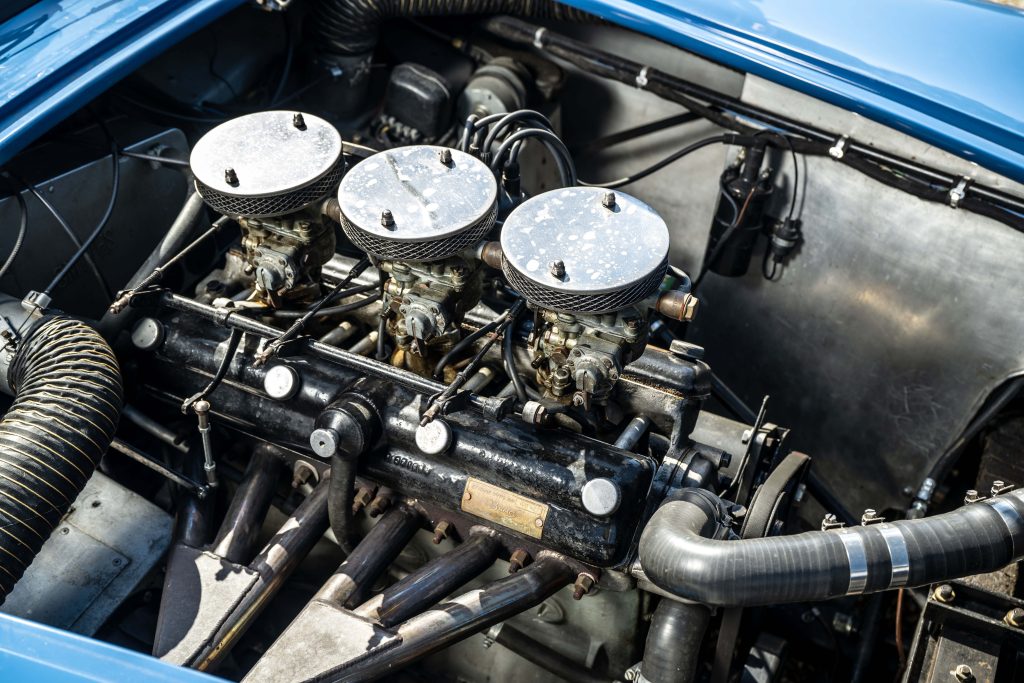
Launched in 1936, the BMW/Bristol six-cylinder engine was originally designed by BMW’s senior engineers Rudolf Schleicher and Fritz Fiedler for the epochal 328 sports car. As my colleague and friend John Simister puts it in his book Legendary Car Engines, the story that this clever pushrod-actuated, hemispherical head ‘six’ was handed to Bristol, the aeroplane maker, as part of its war reparations, isn’t the entire truth, but my hat, what a lovely piece of kit this engine is.
The version of the famous long-stroke, triple-carburetted 2-litre ‘six’ in front of me now was built at the workshops of Jim Stokes in Waterlooville, Hampshire and while it’s in a very soft state of tune, there’s heft and intent in the vibrato exhaust note; ready for battle even if that’s just popping down to the pub. As it growls and grumbles into warmth, I’m watching the rev counter and the tiny needle of the water temperature gauge.
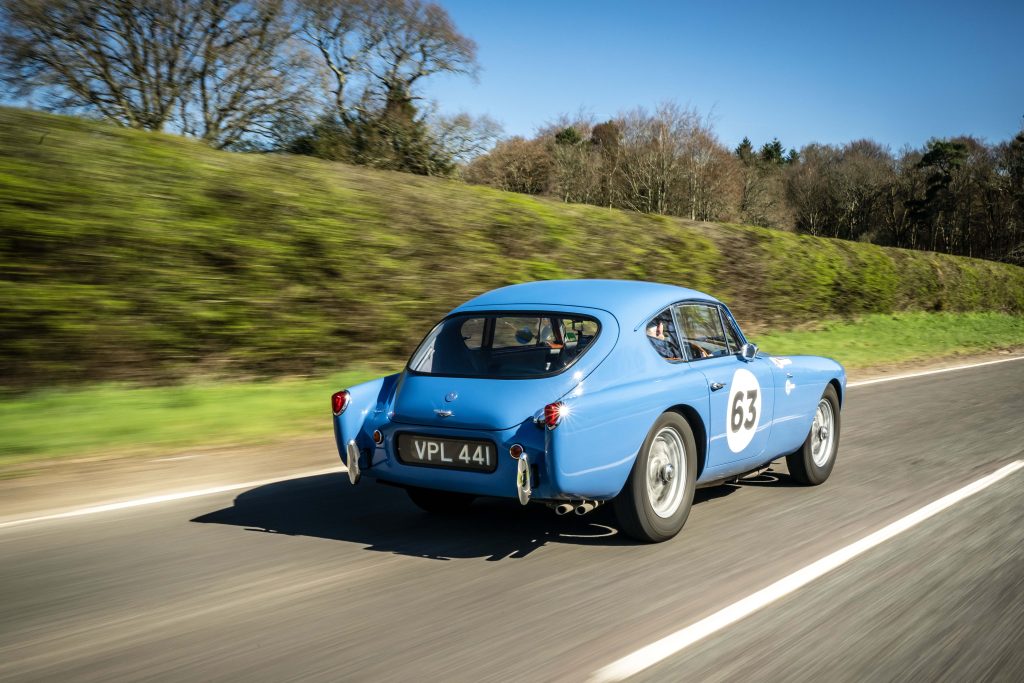
Small wonder the first user of this car demanded that AC fitted this 120bhp Bristol BMW engine as soon as it became available, for it was a premier cru heart compared with the old AC 2-litre six-pot plodder with which the AC Aceca was first born.
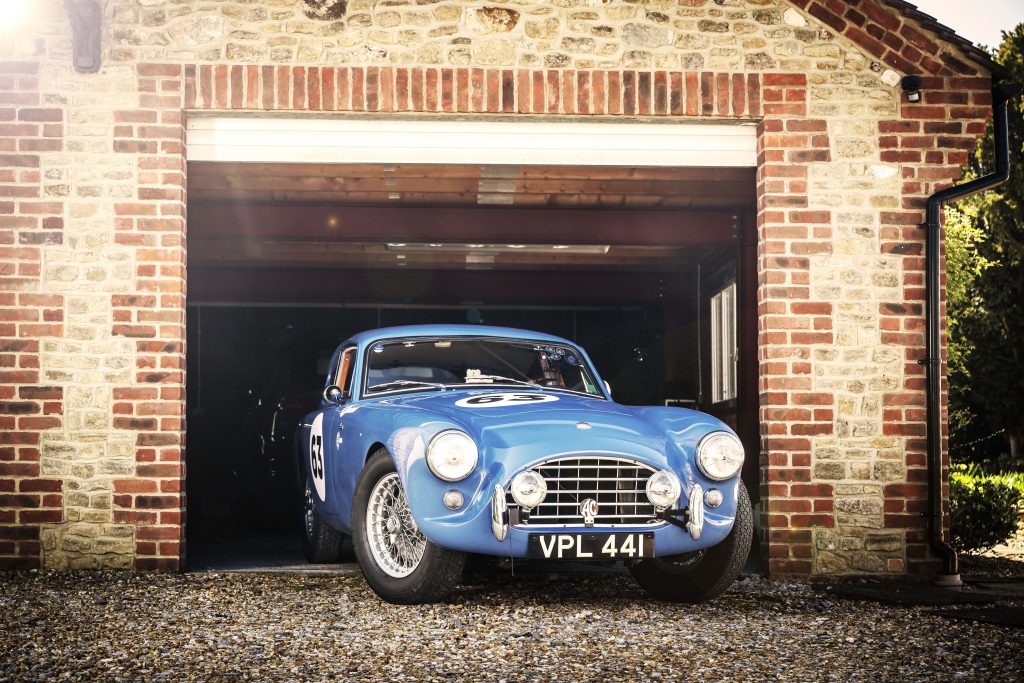
And this car was there right at the birth; the prototype in fact, which stood on the AC stand in Earls Court for the 1954 Motor Show. Registered VPL441, this AC two-seat coupé would be an important car in its own right with an interesting history, but there’s a twist to the tale – a fast and famous former owner…
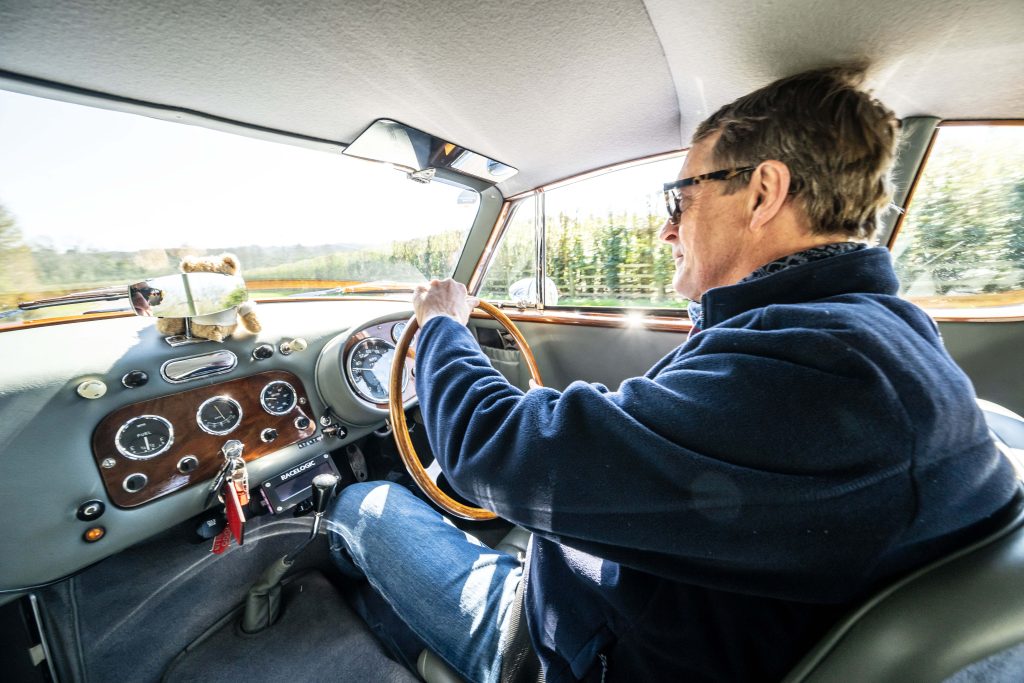
Before we get to that, however, engage first, lift the clutch and pull away. The Bristol engine is known for its love of revs and the vulnerable centre main bearings don’t like slogging low down in the rev range, so a modest boot full is best to get going, though this is someone else’s car and it’s up to me to look after it. Carburation is notorious to get right on these cars and this one is a peach, pulling well from just below 2,000rpm, breathing deeply in the mid-range and then soaring above 5,000rpm where the knitting-needle pushrod arrangement can get flustered.
Culshaw and Horrobin’s Catalogue of British Cars gives the Bristol-engined Aceca a top speed of 115.5mph, 0-50mph in 8sec [sic], an average of 20.5mpg and a 17.8sec standing quarter, compared to equivalent figures for the first AC-engined Aceca of 105mph, 9.4sec, 26.5mpg and 18.9sec. This example feels capable of all of the former figures, actually a bit faster. Worth remembering that in its later years, this remarkable engine was highly developed for use in the Formula Two Cooper Bristol, so the know how is there to get serious horsepower and torque, too, as the block can be stretched quite a bit.
Still dressed for Goodwood’s Revival meeting, this ultramarine-blue AC garners attention and admiring glances. Small wonder since the all-aluminium alloy coachwork design was rumoured to be based on that of a Pininfarina study done for AC in the 1940s. Underneath was the Ace sports car’s John Tojeiro-designed ladder-shaped, tube-frame, with independent suspension, sprung with transverse leaf springs front and rear.
Tops, tails and that all important gap between the long bonnet and windscreen are critical with a small, two-door coupé. When they are right, they should appear effortlessly perfect, more surf board than car as if riding a wave of water rather than Tarmac. Think Alfa Romeo’s Bertone 105/115 coupés, Triumph’s little GT6, or Ferrari’s 166 Inter GT, but not perhaps Hyundai’s Velostar, or BMW’s M Coupé. Added to which, after John Turner’s design for the Aston Martin 2/4 two-plus-two hatchback, the Aceca is the second such car to have a lift back.
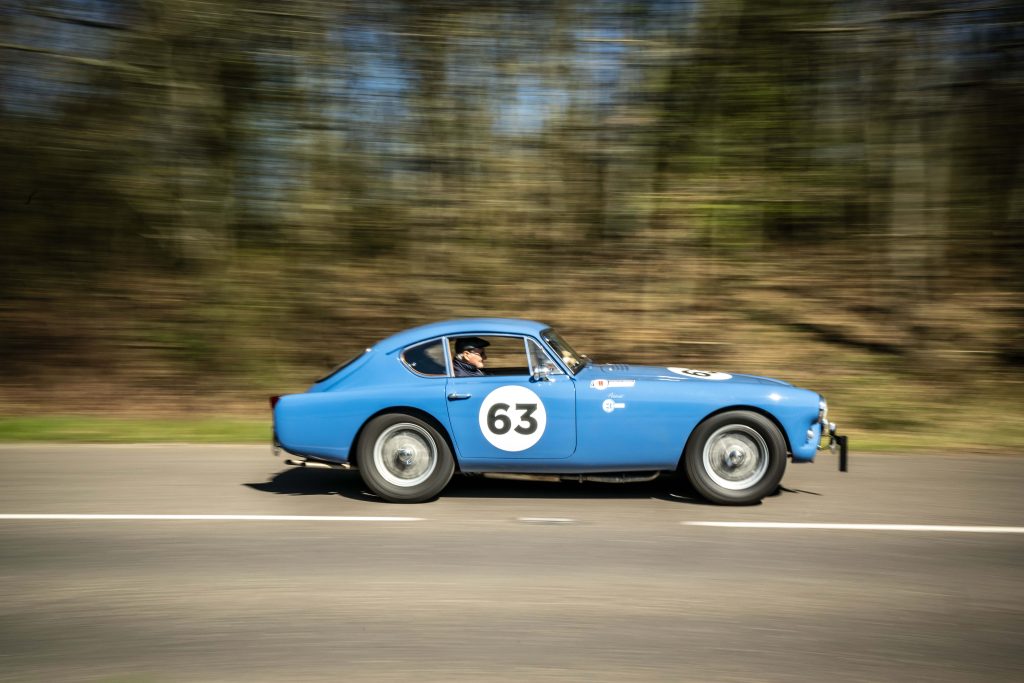
The Aceca seems to veer wildly between decades as you walk down its length. The egg-crate grille, simple over riders (standard cars had twin tubular bumpers) and small windscreen are pure Fifties. The bonnet length is longer than it need be because of the transverse spring set up, but that also means the engine is set back in the frame to improve handling balance. Then, inside, there’s the upholstered fascia with its multitude of instruments and inset polished wood panels which feels more like the Sixties. The B pillars with that stunning fillet of wing just in front of the rear wheel shows the attention to detail of the great Italian carrozzeria and the rear hatch is right back at you from the Seventies. As to that rear side-screen kink and the thick C-pillar, well think about what the great Wilhelm Hofmeister was doing for BMW in the same period.
With 16-inch wheels shod with narrow Pirelli Cinturato CN36 tyres of the right height and tread pattern, the ride is good if firm and if the worm-and-gear steering isn’t the last word in speed and precision, the loads are light and there’s not a lot of free play in this one. Corners are engaged with caution and thought, but you can carry speed through the turn and the throttle also helps in the direction and attitude. You probably wouldn’t want to be jabbing the anchors while heavily loaded up, but with big, but narrow drum brakes all round, as owner Kevin Shilling says: “the brakes don’t really stop the car, they’re more about slowing it down”.
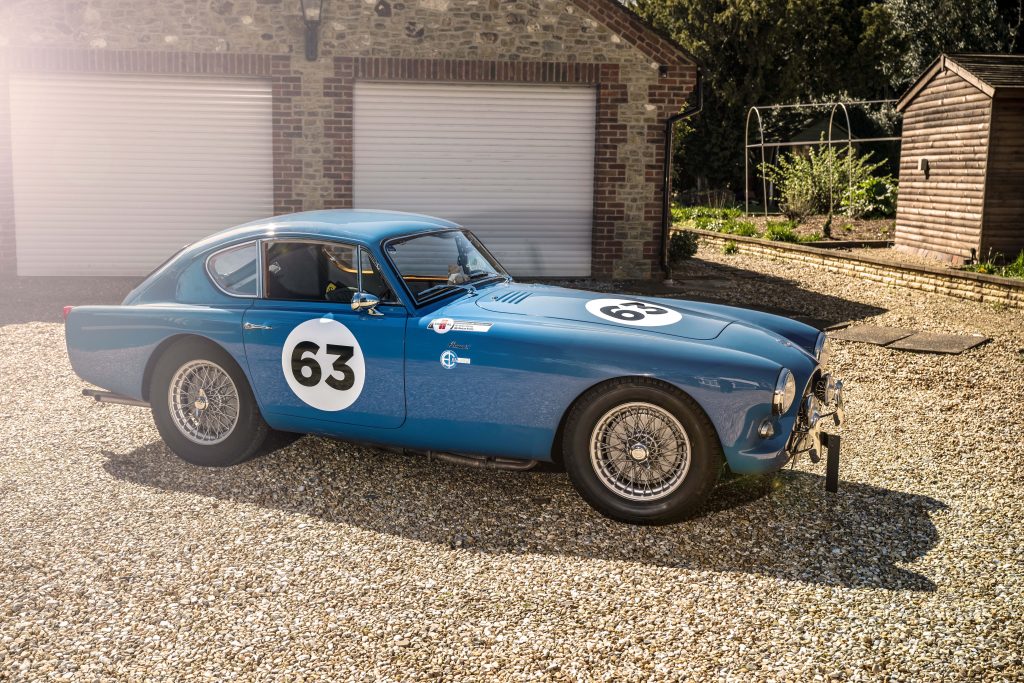
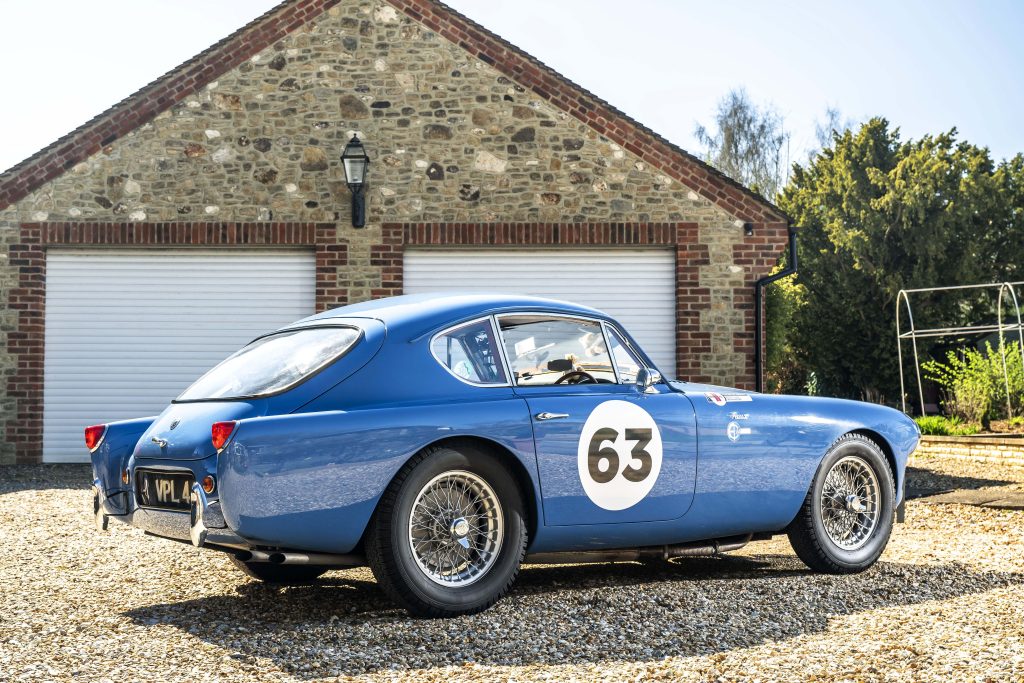
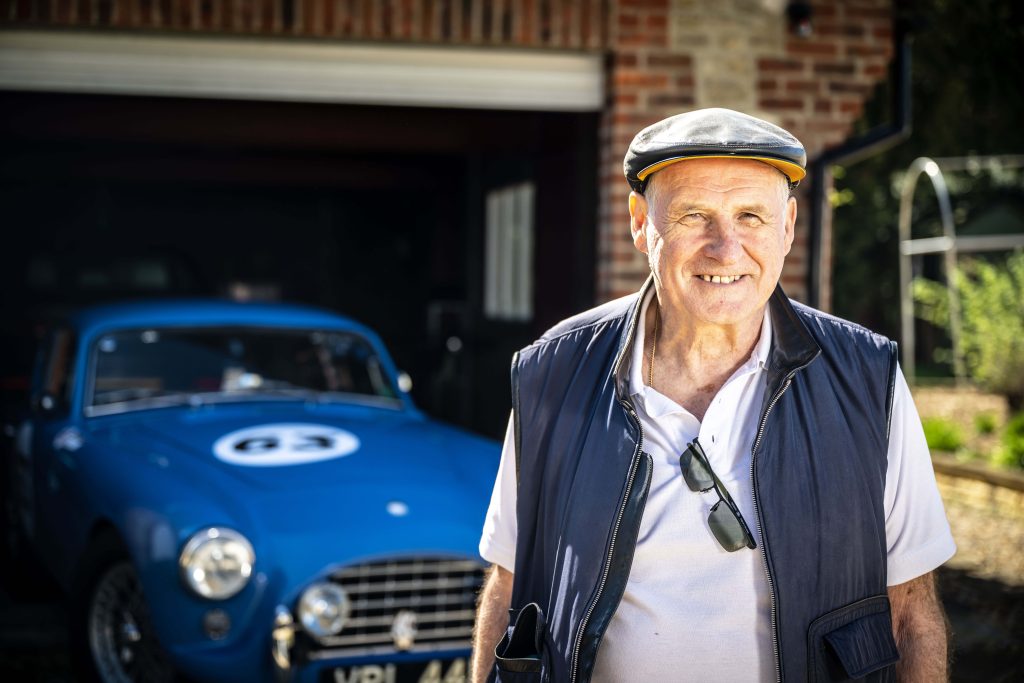
Let’s come back to the famous owner here and the question is does a famous owner bestow greatness? And in this case, does a celebrated coachwork colour do the same? If I told you that not only was the first long-term user of this prototype car the notable speed record breaker Donald Campbell, but that it is also painted in the actual paint left over from his K7 jet-powered hydroplane in which he met his end, would you swoon like an Edwardian lady?
In order to match the original paint during its restoration, contact was made with the team restoring Campbell’s water speed record boat, recovered from Coniston Water in 2000. A small section of the hull not being reused was sent for scanning to match the colour, before a small amount of the hull’s paint was removed, ground to a powder and added to the new paint to be applied.
One man, according to Shilling was so moved by the experience of sitting in the passenger seat, he wept. The car most closely associated with Campbell is his 1966 Jaguar E-Type Series-I, 4.2-litre coupé registered GLM37C (and later DC7) and painted in opalescent silver blue. Poignantly, after his death in January 1967, it was left parked outside Pier Cottage on Lake Coniston for a few days before it was taken away and put on sale.
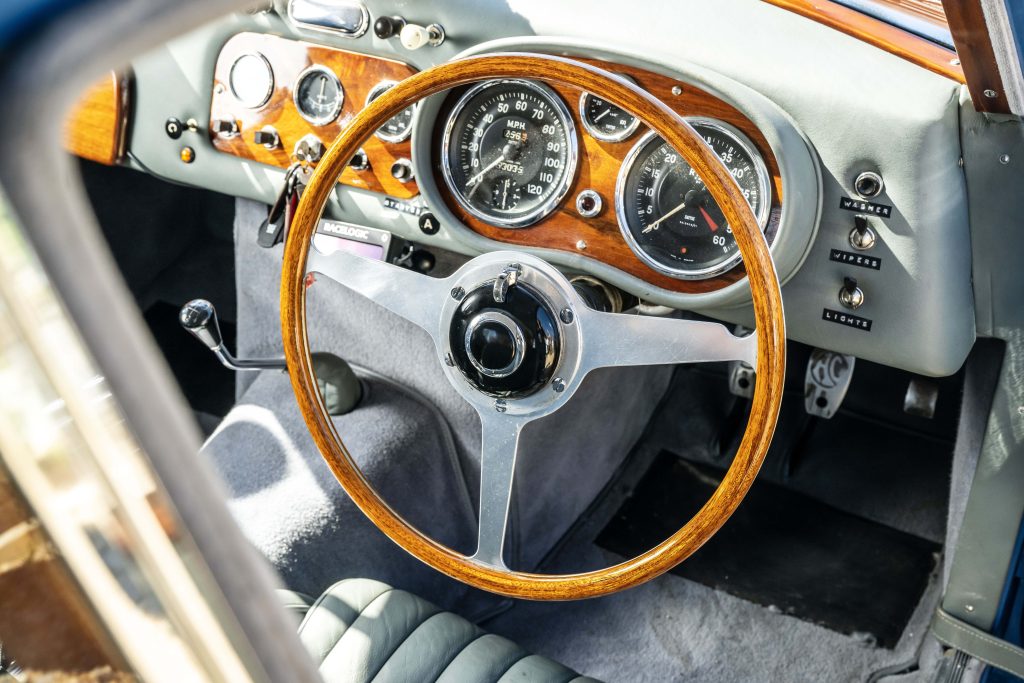
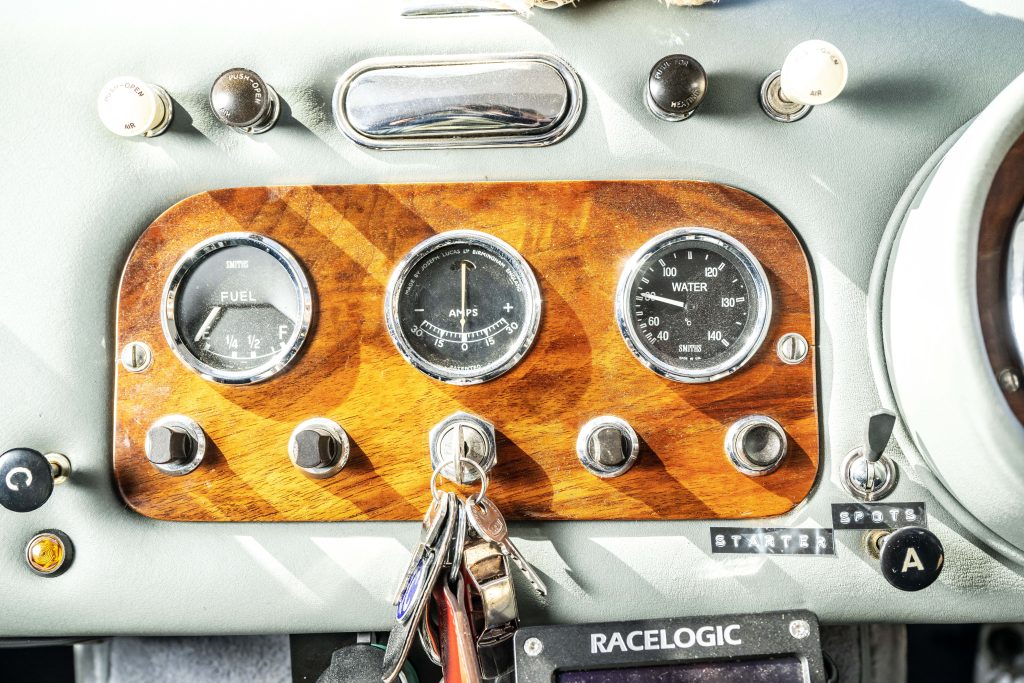
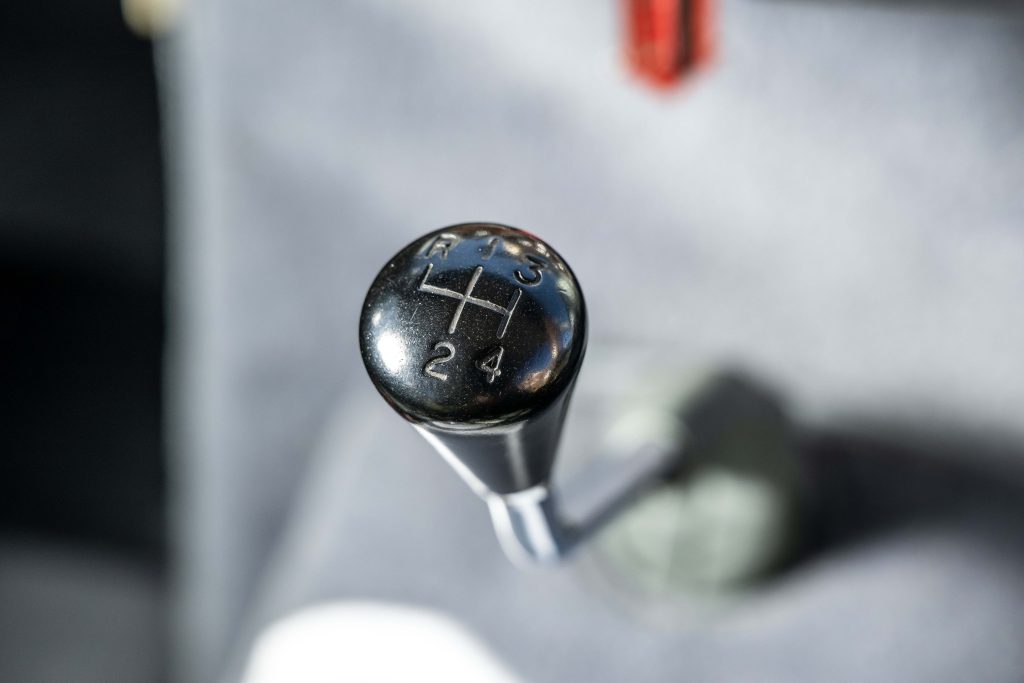
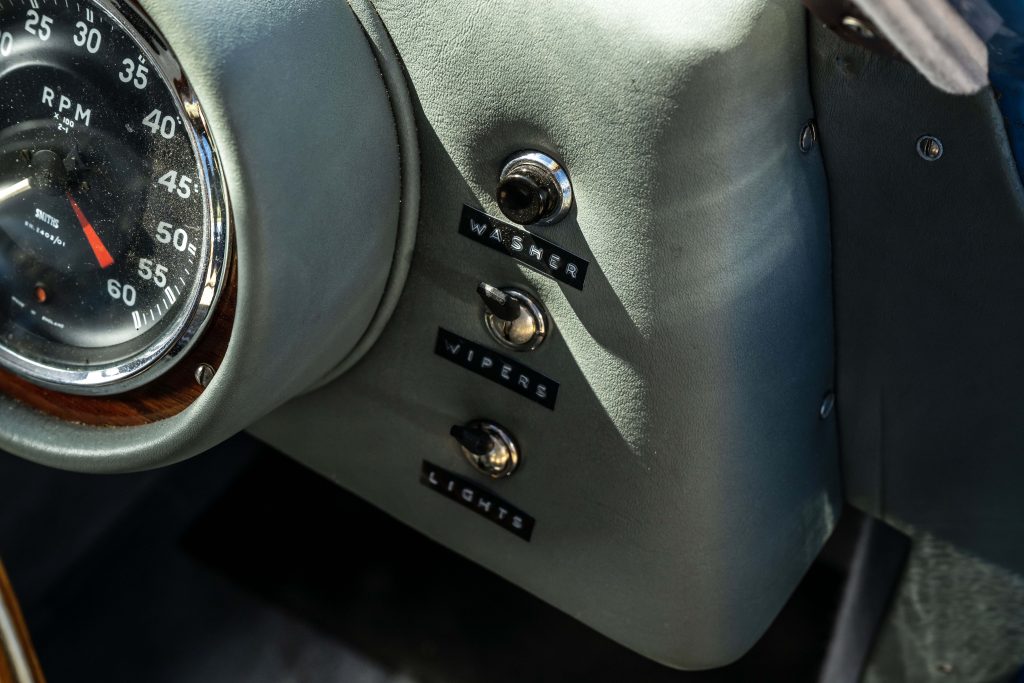
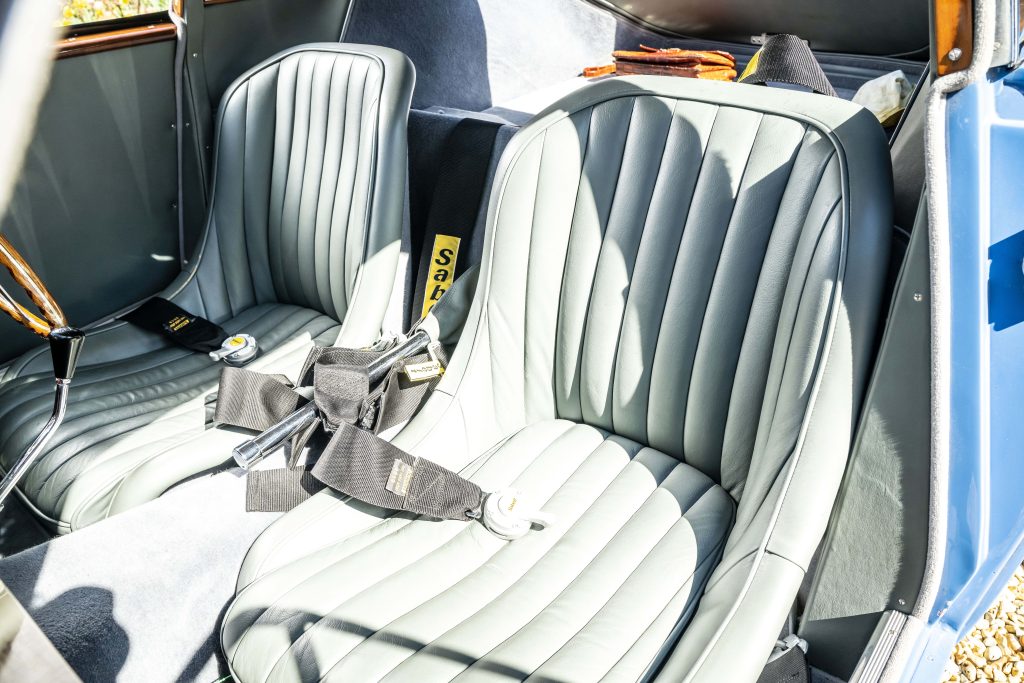
Campbell wasn’t the best of bets for car makers seeking to capitalise on his fame, either, since after scouring my battered copy of his 1955 book Into The Water Barrier, I can find no mention of the little AC coupé, which he should have been driving up and down between his home in Reigate, Surrey to Coniston in the period. Nor was it, according to Shilling, who has conducted extensive research into the car and written his own book, Reckless – The Fall And Rise Of AC ‘Bluebird’, actually owned by Campbell, but it was loaned to him by AC’s owners.
Shilling takes up the story. “By all accounts Campbell used the car for three years, which is the longest he had kept any car for. He had the car sprayed Bluebird blue and used the car with the full consent of the Hurlock brothers, as a marketing ploy to promote AC (Acedes) Ltd, to the wider public.”
Quite a smart piece of marketing by Shilling, too. Associating his old AC with the Campbells, the greatest of record-breaking families, specifically Donald, Sir Malcom’s son and possibly the bravest water and land-speed record holder, with the most haunting and moving story.
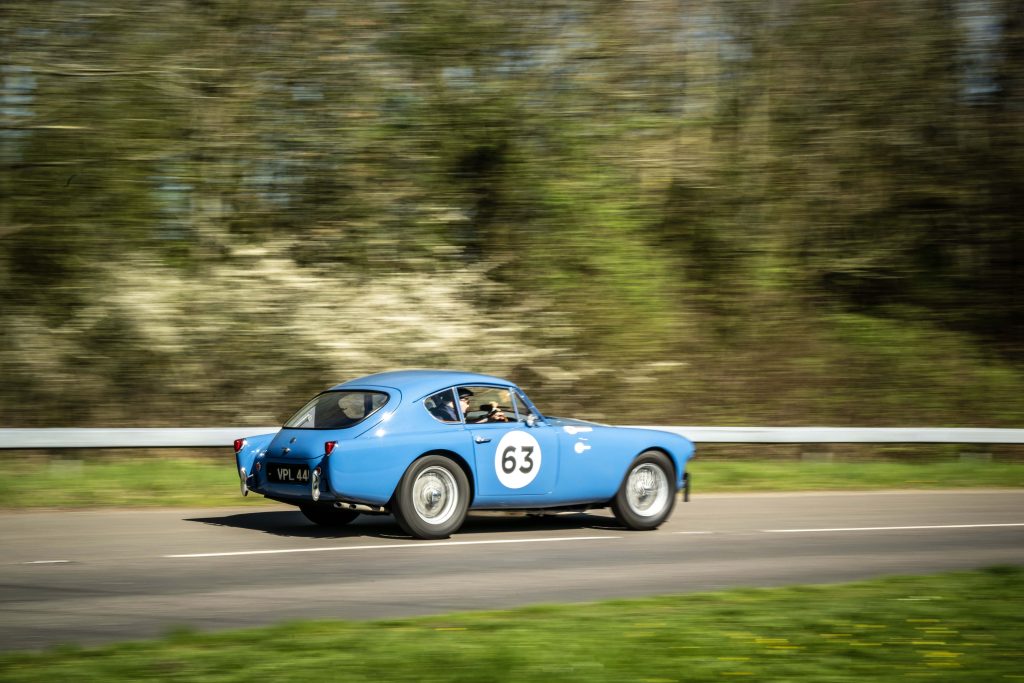
Shilling’s background in financial communications not just gave him the wherewithal to buy and restore the old car, but also to go racing and historic rallying in such Blue Riband events as the Mille Miglia retrospective and the Goodwood Revival. It gave him the know how into rebranding stuff, such as this car which he has named ‘AC Bluebird’, after a mechanic’s throw away comment in Stokes’s workshop. There’s a logo, merchandise (hats, jackets and tees) and web site to go with the car, even a QR code in the book10 automotive marriages made in heaven.
And Shilling, who admits he must have spent well over £200,000 restoring and preparing the Aceca for events, which is almost as much as he bought it for, admits that the outlay won’t have done the car’s value any harm either. He claims he’s been informally offered more than a million dollars for his AC. To give a sense of perspective here, you can currently find what looks like a tidy, matching-numbers, Bristol-engined AC Aceca offered at an asking price of £140,000. In July 2003, Shilling’s VPL441 went under the hammer at the Bonham’s Goodwood sale. Contentiously described as being “sold to” Donald Campbell, the catalogue explained that it had been “rediscovered” in Devon in 1985 and restored over a five-year period, with more than £30,000 spent on it which helped it to enjoy some concours success in subsequent years. It sold for £31,625.
Shilling says he’s had some kickback from the AC Owners’ Club members about the remorseless machine that this AC has become and I understand that. For those who’ve spent what seems like months lying on freezing garage floors restoring, mending and maintaining their cars, keeping the reputation alive, Shilling’s seemingly bottomless cheque book may be hard to stomach. But Shilling’s nobody’s fool and though he doesn’t make this point, a rising tide raises all ships and if he really does sell his blue AC for over a million bucks, that could rub off on the value of all Acecas.
In the end, this is a really nicely restored and maintained, important little coupé, which is a pleasure to drive and has been set up so that an amateur driver can have some fun and not scare themselves witless. What Donald Campbell thought of it other than it being free wheels we can only guess at. I say good luck to Shilling and his car because even if it’s cost him a small fortune, it’s been an adventure and he’s been having fun doing it. And surely that’s the whole point of classic cars, isn’t it?
Read more
10 automotive marriages made in heaven
Cars That Time Forgot: AC Ace Autokraft
Ace’s high: Unregistered AC without a chassis made £200,000 at auction
I remember AC Aces being raced at Goodwood in the 1950s and always thought they were very good looking cars. This article does nothing to detract from that memory. That Bristol/BMW engine was superb. I once had the pleasure of driving a 328 from Central London to west Surrey. The whole package was beautiful and the gearbox one of the best.
It’s a nice restoration, but bragging about values does nothing for the old car movement
Just enjoy and use it
I am sure this is the Aceca I saw on the Diy shop car park in Eccleshall about 40 years ago. The owner , an AC Owners Club member was buying Nitromors to strip the paintwork. He commented that it was the prototype and had belonged to Campbell, he was planning to have it re-upholstered and my comment was to leave it alone, Donald Campbell’s bum has sat on that seat, he thought that was not a good reason to leave well alone.
The car will fetch what the market will decide. It is a fashion statement like all art. The lines will come and go, the quality however, should be timeless, if the restoration has been done well. It really depends if the owner just did it for the money and just wants to flip it or if he really cares, in which case it is a keeper. I hope the latter. We will get to see it put through its paces, enjoy hearing that exhaust note on the track or wherever and eventually it will come to the market again with a little more history and a little less mystery.
I wish I could have been able to keep the one I had but the problem was that the Aceca was way out of league. I was not earning much money and just couldn’t afford to run it. However, while I had it I was king of the road! Hope its still around. 3759 BP
Mr Shilling says that VPL 441 was used by Donald Campbell for three years, but his own website notes that it was registered by AC in November 1954 (the Motor Show was in October that year) and sold to its second owner, Mr R Hawker, in December 1956. So even if Campbell drove it for almost the entire time it belonged to AC then he could not have had it for more than two years. I don’t see any evidence that this car was ever painted ‘Bluebird Blue’ (every photo of it on Mr Shilling’s site shows it black, or in one case showing the remains of a black paintjob) or that it was called ‘Bluebird’ by Donald Campbell. Seems like a bit of stretching
Miles Cross, your post is more factual than many regarding this vehicle.
I suspect the current owner is the only person to ever have called this vehicle Bluebird, and ultimately because of the Campbell connection to Donald.
It’s lovely but appears to have been restored to a degree where any feeling of its past has been lost. You can’t restore originality. It reminds me of John le Care’s spies creating ‘a legend’.
It was my father Euan Clayden who found VPL 441 leaning against a shed near Torquay, a letter to AC confirmed that it had been used by Donald Campbell.
Restoration began, the car was kept in an unlocked shed near our house, the only problem was that my father was restoring about 12 other cars, because he loved them all.
After a few years it was sold to Mr and Mrs Nicklass for them both to race, sadly Mr Nicklass died, his wife continued to race VPL.
I found the original log book and posted it to Mrs Nicklass, it belonged with the car.
It’s nice to see it again and know that VPL is still racing ❤️❣️❤️