Author: Nathan Chadwick
Photographs: Manufacturers
How Oldsmobile’s Toronado used bold design and front-wheel drive to change American car engineering
The Oldsmobile Toronado arrived in 1966 like a controlled detonation inside General Motors. Not because it was loud or flamboyant – though it could be both – but because it quietly dismantled one of Detroit’s most deeply held assumptions: that big, powerful American cars simply could not be front-wheel drive.
To understand why the Toronado mattered, you have to rewind to the early 1960s. Oldsmobile, once GM’s technology leader, was drifting. Cadillac had claimed the prestige high ground, Pontiac the performance crown, Chevrolet the sales charts. Oldsmobile needed relevance, something bold enough to reassert its identity without alienating its conservative customer base. Internally, there was also unfinished business. GM engineers had been fascinated by front-wheel drive since the Cord 810/812 of the 1930s, but no one had yet cracked the problem of making it work reliably with serious torque and mass.
The Oldsmobile Toronado began life as a series of experimental studies, most notably the XP-784 concept. These were not styling exercises first and engineering later; they were holistic attempts to solve a packaging problem. The brief was deceptively simple: build a large, luxurious American coupé with no transmission tunnel, excellent traction, and a low, dramatic stance. Hence front-wheel drive.
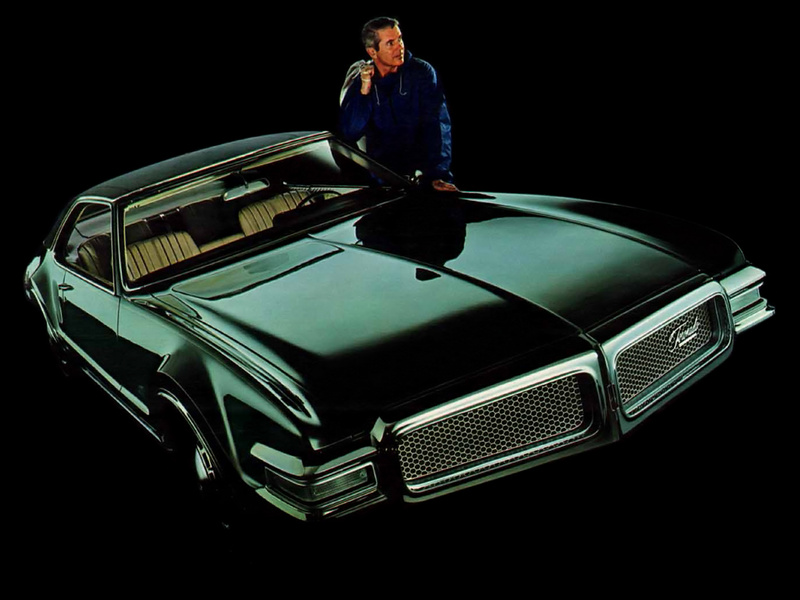
Oldsmobile took its new 425-cubic-inch Rocket V8 – later expanded to 455 cubic inches – and paired it with a bespoke three-speed automatic transaxle, the Turbo-Hydramatic 425. Power was sent forward and then turned back on itself via a silent Morse chain drive, allowing the engine to sit longitudinally while driving the front wheels. This layout solved torque steer, packaging and durability in one elegant, if complex, stroke. The chain drive alone looked like something borrowed from heavy industrial machinery rather than a passenger car.
What made this remarkable was not just that it worked, but that it worked immediately. There was no timid pilot run, no low-powered test case. The Oldsmobile Toronado launched with over 380lb ft of torque, enough to embarrass many contemporary muscle cars, yet it delivered that power through the front wheels with surprising composure. Traction in poor conditions was genuinely superior, and the absence of a transmission tunnel transformed the cabin into a vast, flat-floored lounge.
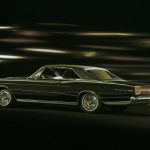
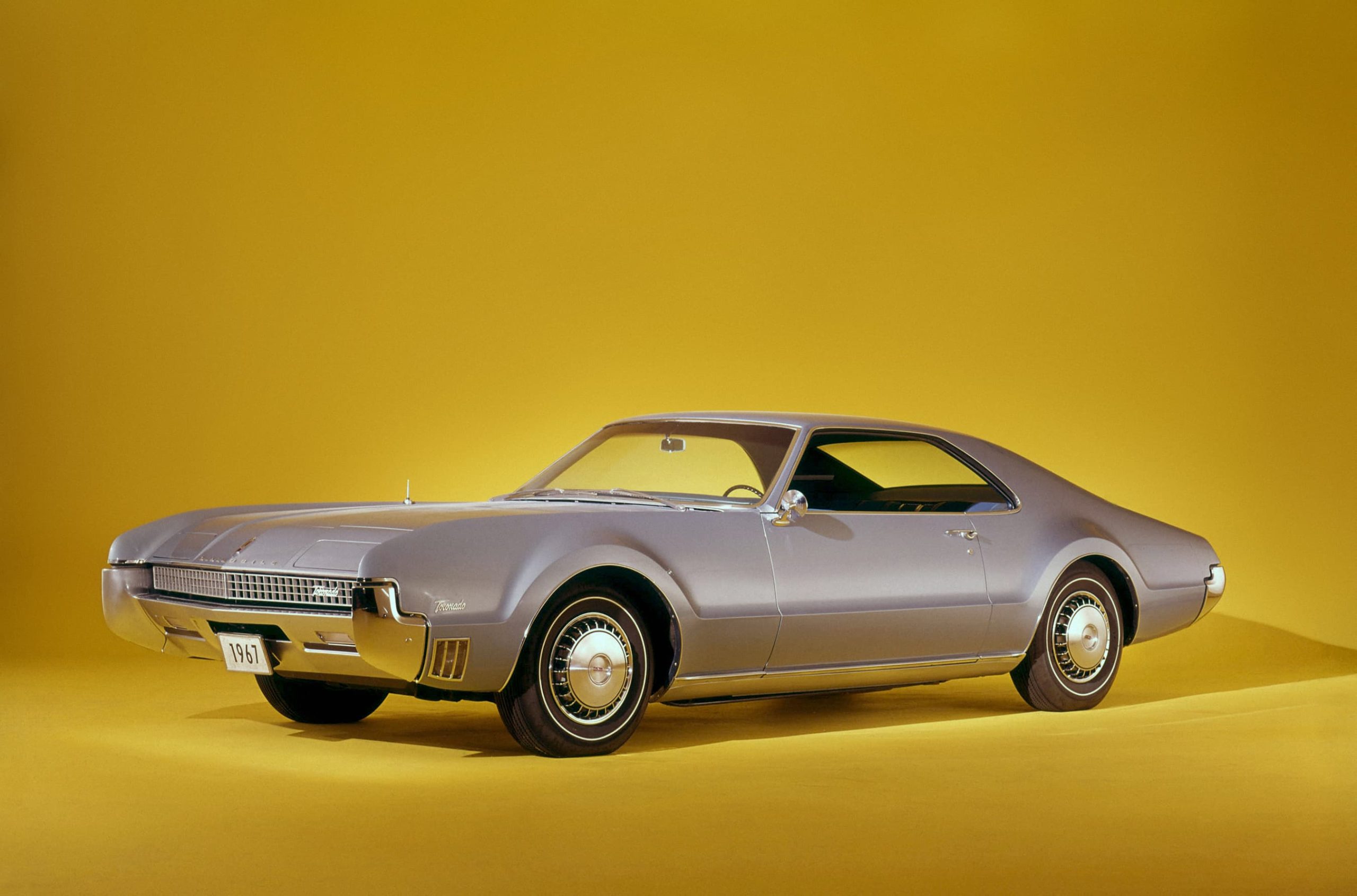
Visually, the Toronado was just as disruptive. Styled under Bill Mitchell’s watch, it rejected Detroit’s excess in favour of a clean, almost European sense of proportion. The 1966–70 first-generation cars remain the purest expression: long, low, and unapologetically horizontal. The hidden headlamps – then still a novelty – gave the nose a smooth, architectural confidence.
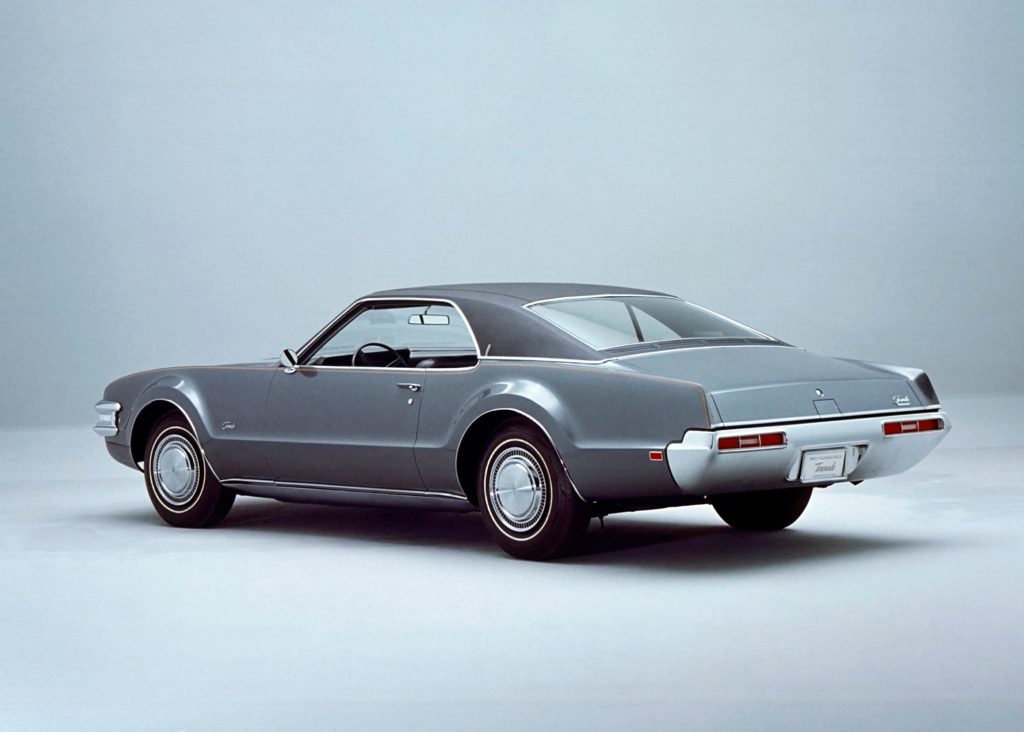
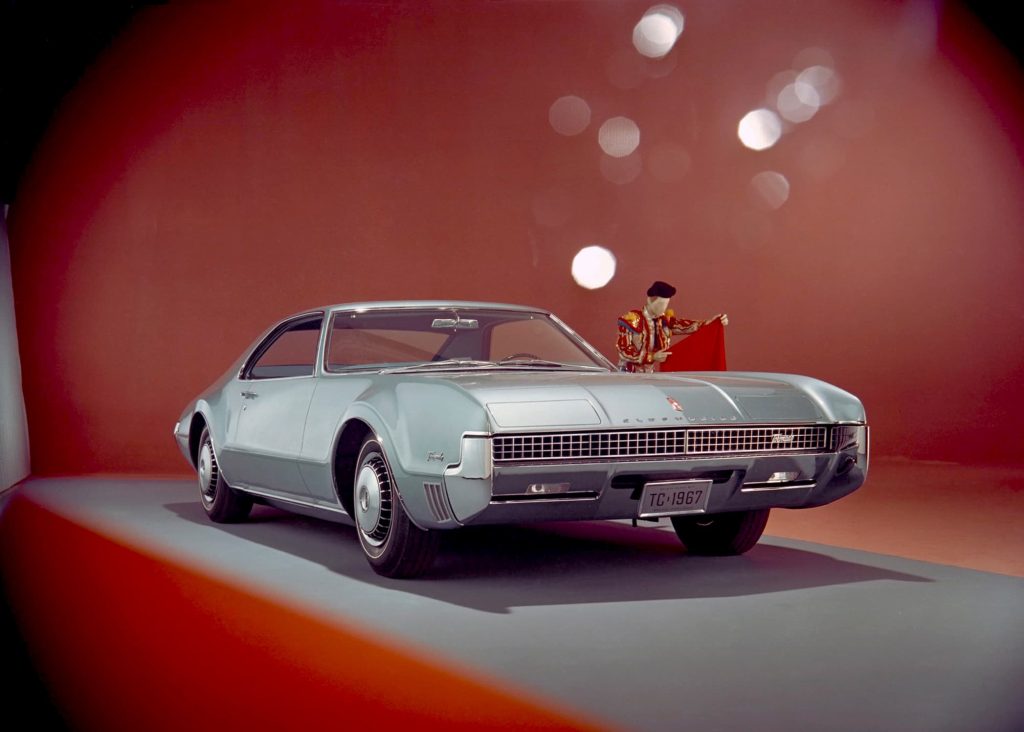
There was no attempt to disguise the Oldsmobile Toronado as a conventional luxury car. Its proportions were unfamiliar, its surfaces taut, its detailing restrained. The sheer length of the bonnet was not there to shout power, but to balance the mass visually. In an era of vinyl roofs and chrome for chrome’s sake, the Toronado’s relative restraint felt almost radical.
Inside, the Toronado doubled down on its futurism. The dashboard wrapped around the driver in a way that felt closer to aviation than boulevard cruising, while the flat floor and wide cabin made even large American interiors of the time feel cramped by comparison. Materials were rich, if typically GM, but the real luxury was space and calm. This was a car designed to devour interstates at speed, not parade outside country clubs.
Crucially, the Toronado was not a one-off indulgence. It was engineered for production, longevity and scale. GM was confident enough in the platform to spin off the Cadillac Eldorado in 1967, effectively validating front-wheel drive at the very top of its hierarchy. That alone tells you how seriously the Toronado was taken internally. Oldsmobile, briefly, was back at the centre of GM’s technical universe.
Yet the Oldsmobile Toronado’s brilliance also contained the seeds of its limitations. It was expensive to build, heavy and mechanically complex. While reliability was generally good, servicing was not for the faint-hearted, and as emissions regulations tightened in the 1970s, the big V8s that made the Toronado so compelling became liabilities. Subsequent generations grew softer, heavier and less distinctive, their front-wheel-drive layouts increasingly overshadowed by downsizing and platform sharing.
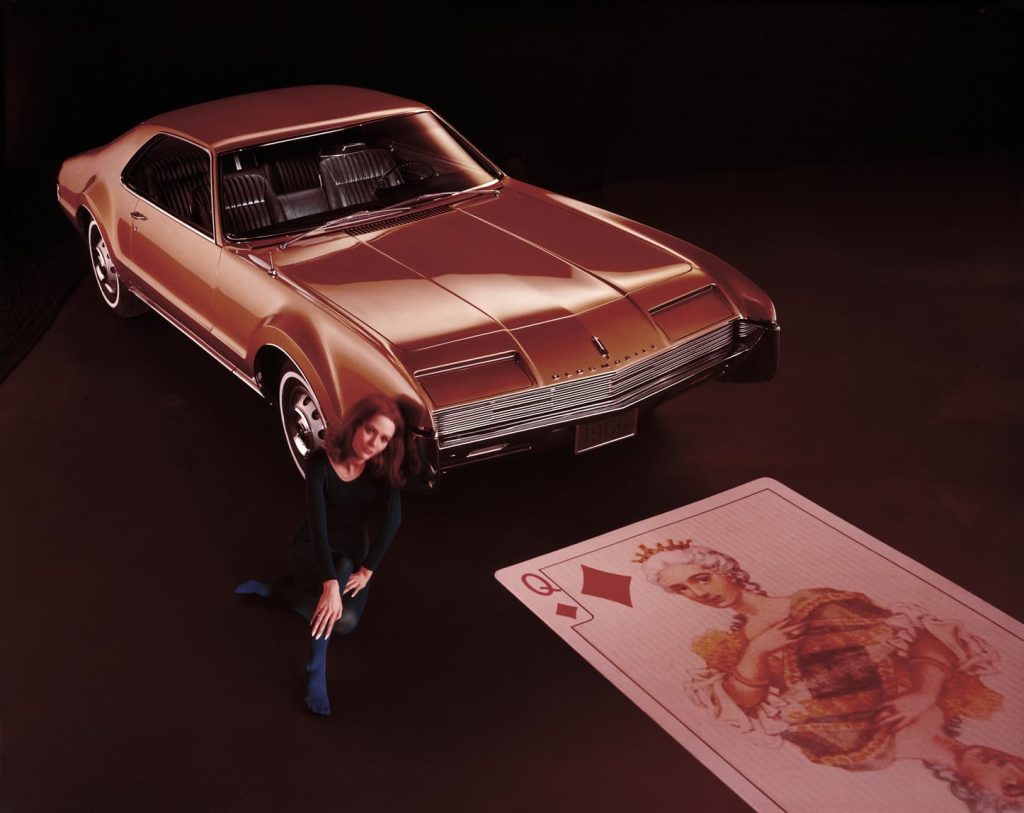
By the late 1970s and into the 1980s, the Toronado had lost its edge. What had once been a technological statement became just another personal luxury coupé, albeit a competent one. The engineering was still there, but the sense of purpose had faded. When the Toronado finally disappeared in 1992, it did so quietly, without ceremony – an ignominious end for a car that had once rewritten the rulebook.
And yet, the Toronado’s legacy is far larger than its sales figures or lifespan suggest. It proved, unequivocally, that front-wheel drive could handle serious power in a large car. That lesson filtered through GM and beyond, shaping everything from luxury saloons to performance hatchbacks decades later. The Toronado also stands as a reminder of a time when Detroit was willing to take risks not just in styling, but in core architecture.
Culturally, the Toronado occupies a fascinating middle ground. It is neither muscle car nor traditional luxury barge, neither European mimic nor pure Americana. That ambiguity is precisely why it resonates today.
For enthusiasts, the first-generation Toronado has become quietly collectible. It appeals to people who admire cleverness, who enjoy explaining why the chain drive matters, why the proportions work, why this car could only have existed in a narrow window when ambition briefly outweighed caution.
In the end, the Oldsmobile Toronado is best understood not as a failed experiment, but as a successful outlier. It did everything it set out to do – and perhaps that was the problem. Having proven its point, GM moved on, and the industry followed safer paths. The Toronado remains behind as evidence that, once upon a time, Detroit didn’t just follow trends – it made them.
What do you think of the Oldsmobile Toronado’s bold move to front-wheel drive – visionary innovation or unnecessary complexity? Share your thoughts in the comments below.
Read more on American Classics:
Bigger Is Better: 8 American Classics Worth a Look
Cars That Time Forgot: 1963 Chrysler Turbine
Buyer’s Guide: Ford Mustang (1964-1973)