Amsterdam has gained a bit of a reputation. And it’s nothing to do with the red light district or the herby smell you might catch when walking through certain streets, but for its infrastructure.
Once choked by traffic, like many cities, Amsterdam made a concerted push in the 1970s (especially following the OPEC embargo) and then the 1980s to transition away from cars and into other methods of transportation – most notably cycling, but also trams and buses.
How different things could have been. Amsterdam is undoubtedly a more pleasant city for not prioritising cars (though from a tourist’s perspective, you still need your wits about you as a pedestrian with so much two-wheeled traffic careering around), but in the early 1970s the method for dealing with rising oil prices and cloying traffic wasn’t as obvious as it seems in retrospect, and briefly spawned an alternative transportation method: the Witkar.
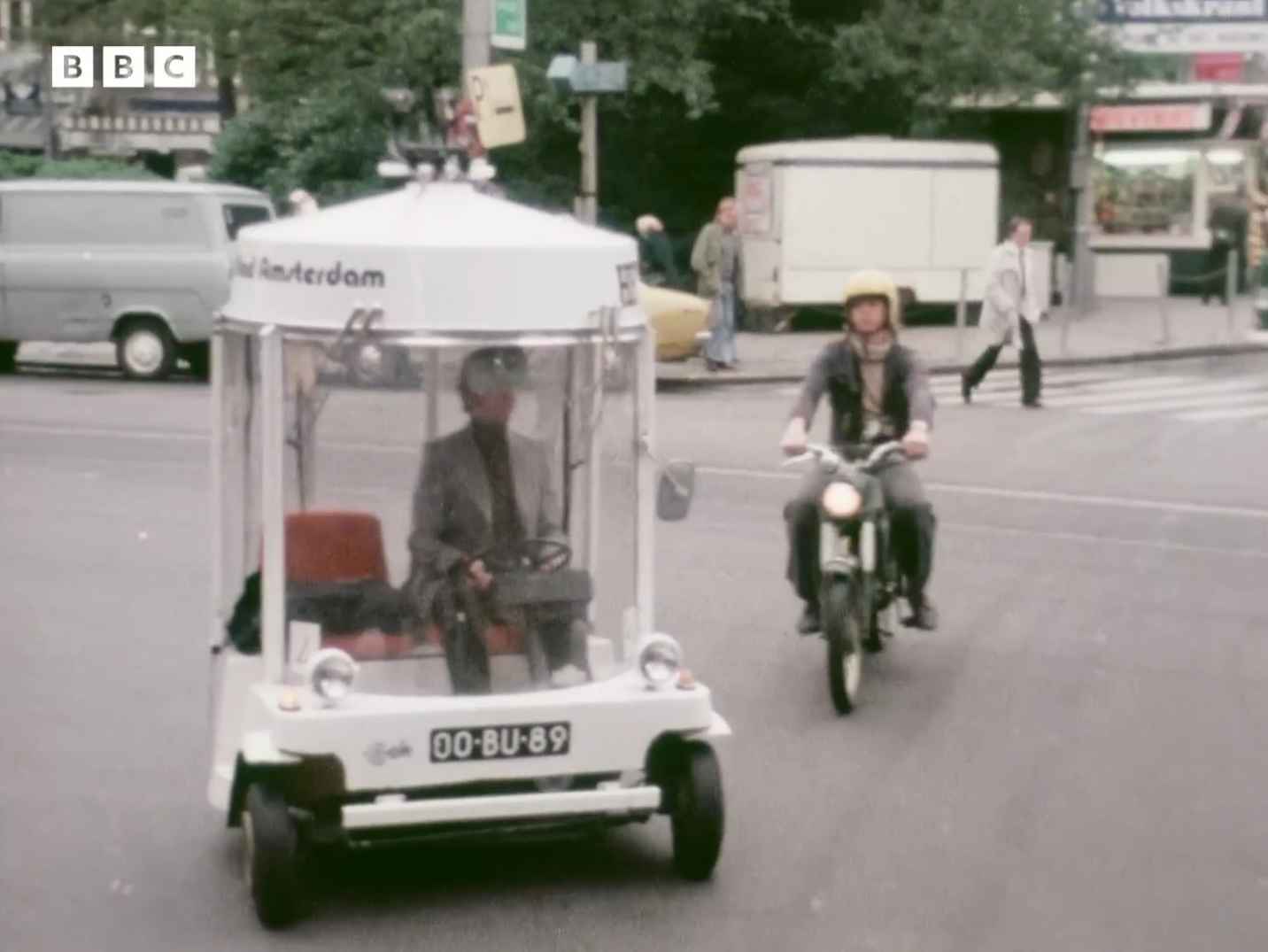
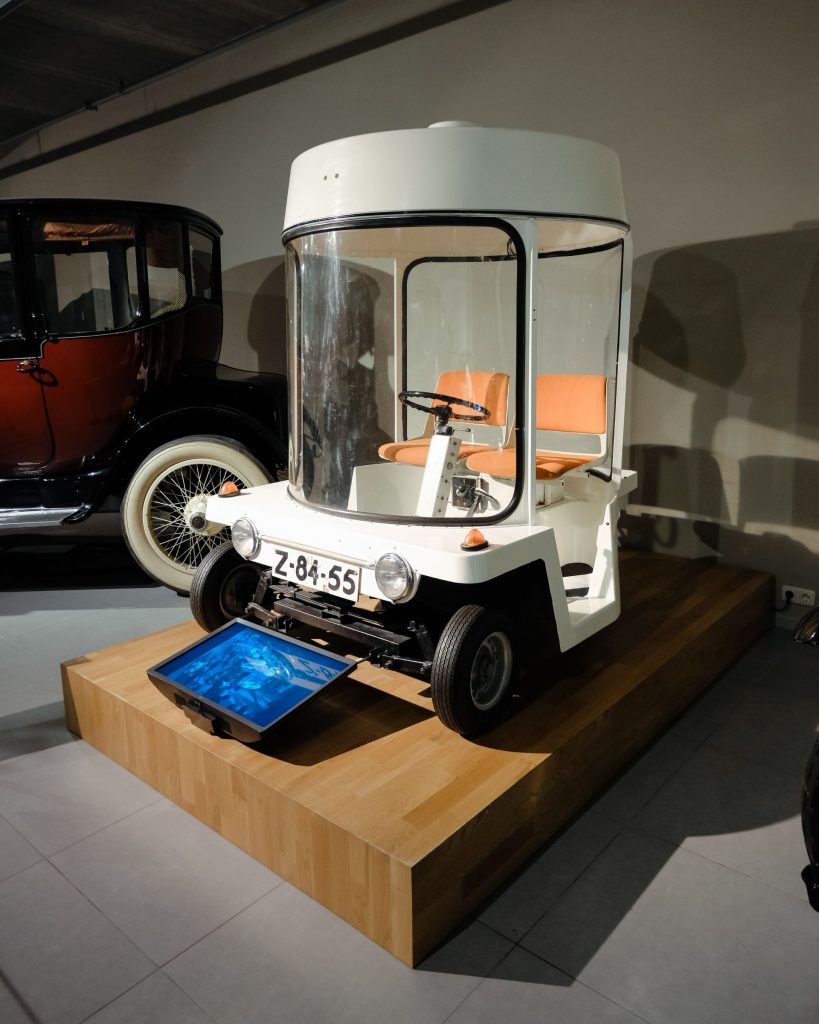
Witkar – Dutch for ‘white car’, for reasons that are clear from looking at any of the images on this page – was conceived as an early example of what we know today as a car-sharing service.
Car-sharing works on the premise that not everyone needs to own a car, but some people may still need to drive one occasionally. In a modern context, that means branded cars scattered throughout cities that you can source, book, unlock and drive using an app, before returning it to a parking space for the next person to use. Dozens of people can potentially benefit from being able to use a single car, without having to stump up the ownership costs, and without cities having to find space for all those extra vehicles.
Most modern car-sharing services simply buy in fleets of existing vehicles, though it’s not unusual for such services to use something specifically designed for the purpose. The Autolib’ car-sharing programme set up in Paris in 2011 used a vehicle called the Bolloré Bluecar, an all-electric city car designed by Pininfarina, and a nice idea other than Parisian driving and parking standards, and then vandalism, quickly reducing the fleet to scruffy jalopies.
You probably wouldn’t have wanted to get into a Parisian-style scrape with the Witkar. Conceived in 1968 by Dutch industrial designer and politician Luud Schimmelpennink, Witkar took the form of a two-seat, fully electric microcar that was notably taller than it was wide or long, and indeed shorter than it was wide, with passengers effectively sitting in an upright glass tube. It was relatively heavy too, at least for its size, at around 600kg, in part a result of the bank of nickel cadmium batteries that supplied a mere 10km (6.2 miles) of range and a 20mph top speed.
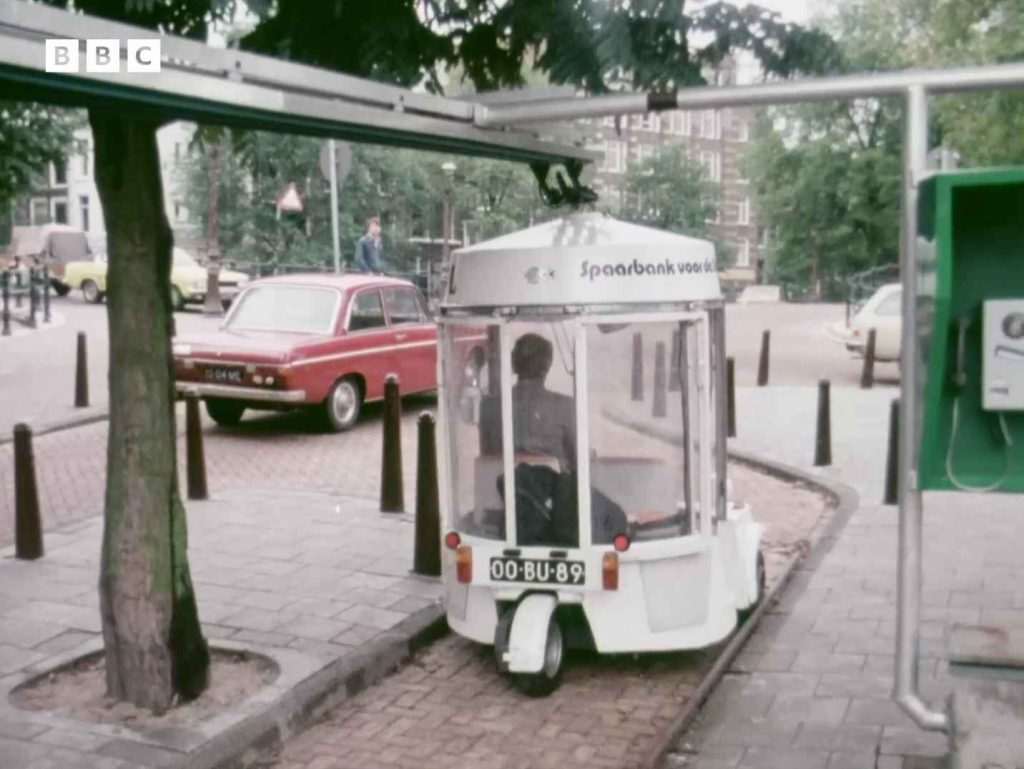
Range wasn’t deemed much of an issue though. More than 4000 people paid the 25 guilder fee (around £4 then, £40 today) to join the Witkar programme when it opened in 1974. Statistics suggested that most people were only covering around 5km (3.1 miles) per journey, before parking at a station where overhead conductors recharged the batteries in an admirably quick ten minutes, ready for the next driver.
To access the cars, each Witkar member received a little plastic key with an embedded sensor for their 25 guilders; pretty sophisticated for the mid 1970s. When they arrived at a station, they’d tap in their destination station using a keypad, and wave the key over a sensor, before driving off. A central computer registered the key, car, and station, and charged each driver accordingly, which typically worked out around one guilder, or 16p (£1.60 in 2026), per trip.
That said, part of the limited distance drivers were covering was down to there being only five stations for the 35 cars. Ten more stations were planned by the end of 1976, for a fleet of 100 Witkarren, and eventually 1400 cars, but predictably that never materialised.
The way it drove probably didn’t help. Chris Goffey, trying out a Witkar for Autocar in 1976, described how it was ‘simple in the extreme’, with a lever for forward, reverse and park, two pedals, and a steering wheel, but that it had ‘extremely sensitive steering [and] a rather top heavy, unstable feel’, for a ‘[not] completely reassuring sensation to the driver’. Goffey did note that other drivers and pedestrians were generally friendly towards Witkar drivers, though.
But he also suggested that, with a widespread tram network and the plans for an underground railway system (the latter starting up in 1977), Witkar demand might never reach fever pitch. Given cars weren’t shunned back then as they increasingly are in the modern city, you’d have to really buy into the relatively minimal benefits of the Witkar (and its goofy styling) to take one over the relatively low ownership costs (including, at the time, mostly free parking) of a regular supermini. There was also an issue with some stations ending up with an excess of Witkars, and others with none, reducing its convenience.
‘Unless they ban all traffic except electric vehicles from large areas of the city centre,’ he wrote, ‘there doesn’t seem to be much of a future for the concept’.
In many ways he was on the money. The trams and metro did take over, and in the 1980s the city quickly ramped up cycling as the primary method of getting around. Witkar soldiered on until 1986 but never grew beyond those original 35 cars and 4000 users, and one imagines usage tailed off pretty quickly through the 80s.
If you want to see a Witkar today, there are examples in some museums in the Netherlands, most notably in the Louwman Museum on the outskirts of The Hague. Driving one however might prove more difficult.
In one respect though the spirit of the Witkar lives on. Walk around Amsterdam today and, while bicycles and bags of refuse seem to vie for space on the city’s pavements and parking spaces, one other type of vehicle remains wildly popular: microcars. Spearheaded by the home-built two-seat Canta microcars, which were originally designed for disabled drivers, the compact vehicles are frequently allowed to traverse cycle paths and seem to be parkable more or less anywhere.
The Canta is a tiny 1.1m wide, narrower than the Witkar (though looking less like a smoothie maker), but it’s far from the only microcar on the city’s streets. Many are of a slightly different format, conforming to Europe’s heavy quadricycle standards, weighing in at 450kg or so and still taking up minimal space on the road.
Citroen’s Ami and its Fiat Topolino equivalent are particularly popular, whirring silently around and taking up minimal space while driving or while parked, and give Dutch drivers a four-wheeled alternative to the predominantly two-wheeled transport. They’re at least a small window into what life might have been like had Witkar succeeded.
*Screenshots taken from Tomorrow’s World, originally broadcast on BBC One, 17 October 1974. Available here.