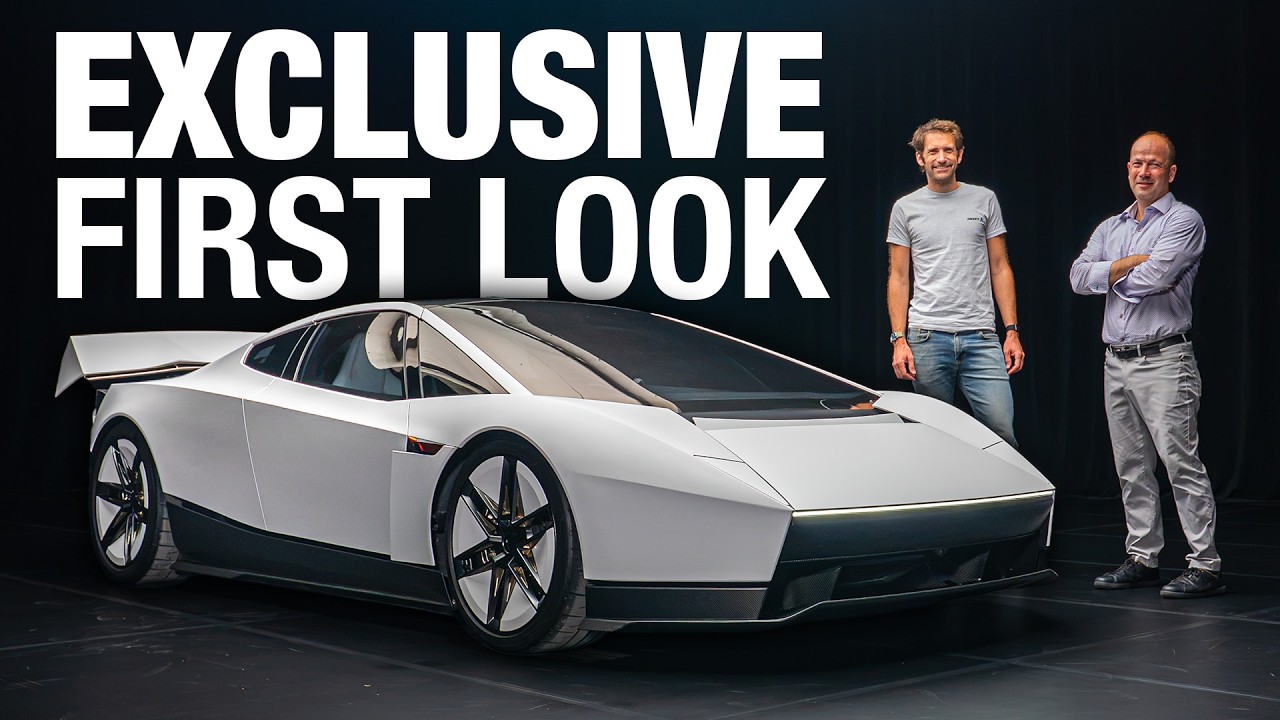
You’ve probably seen by now, that the new Tesla Roadster can fly. And flip. And drive upside down. But how does it do all that? Henry Catchpole met up with Lars Moravy, VP for Vehicle Engineering at Tesla, to talk through all the details of the long awaited new car and see how Optimus and SpaceX helped.
Flying aside, a few things have changed since a new Roadster was teased by Elon Musk over a decade ago. For a start, it is now a two-seater, rather than a 2+2 and the styling, by Franz von Holzhausen, is much sleeker and more in-keeping with traditional supercar wedges. We particularly like the pop-down (not pop-up) headlights, but the moving body panels in general are not only clever but rather beautiful.
There will be three versions of the Tesla Roadster, initially, all with over a megawatt (1341hp) and 1400NM (1033lb ft) from two motors driving the rear wheels alone. Yes, the Tesla Roadster is rear-wheel drive. The Performance model adds fans and skirts into the equation, much like the McMurtry Pure, enabling it to generate huge downforce at low speeds and significantly improve traction.
The Thrust version then adds a quartet of Cold Gas Thrusters (CGTs) to the back of the car. These are fed from a 200-litre tank of compressed Nitrogen that sits behind the seats and help to deliver the Roadster to 60mph in just 0.85seconds. The Rocket version then adds another 400-litre tank in place of the passenger seat and six more thrusters – one in each corner and two at the sides. This is the version that can leave the ground and claims an astonishing 0-60mph of just 0.55 seconds (although that is a rollout figure).
What are your thoughts on the flying Tesla Roadster? Let us know!