Words: Nathan Chadwick
Photography: Lamborghini
A failed military project turned V12 leviathan, the Lamborghini LM002 remains absurd, brutal and brilliant
Today’s performance SUVs are polished, calculated things. They are engineered to within an inch of their lives, assembled from shared platforms, and sold in vast numbers to people who will never take them anywhere more challenging than a damp Waitrose car park.
I know this as a recent convert – my wife recently bought a Maserati Levante in V6 petrol form. They are staggeringly capable, deeply impressive, and about as rebellious as a quarterly earnings report. Yet there are few things I’d rather slink home from a late-night landing at Heathrow in the rain in. But the very first performance SUV was very different..
The Lamborghini LM002 does not so much ignore convention as actively insult it. It is excessive in every measurable dimension, a machine conceived with the kind of decision making process that suggests nobody in the room ever said the word “no”. The nickname Rambo Lambo feels less like marketing and more like a warning.
Its backstory only reinforces the sense that this should never have happened. In the late 1970s, Lamborghini set its sights on a US military contract, producing the Cheetah, a rear-engined off-road prototype powered by a Chrysler V8. The layout was fundamentally flawed, the handling unpredictable, and the military looked elsewhere. That, by any reasonable standard, should have been the end of the matter.
Instead, Lamborghini treated failure as a starting point. The concept was reworked, the engine moved to the front, and the target market shifted from the Pentagon to oil wealth and aristocratic curiosity. Then came the masterstroke of insanity. Rather than install something sensible, they reached into their own catalogue and selected a version of the Countach V12.
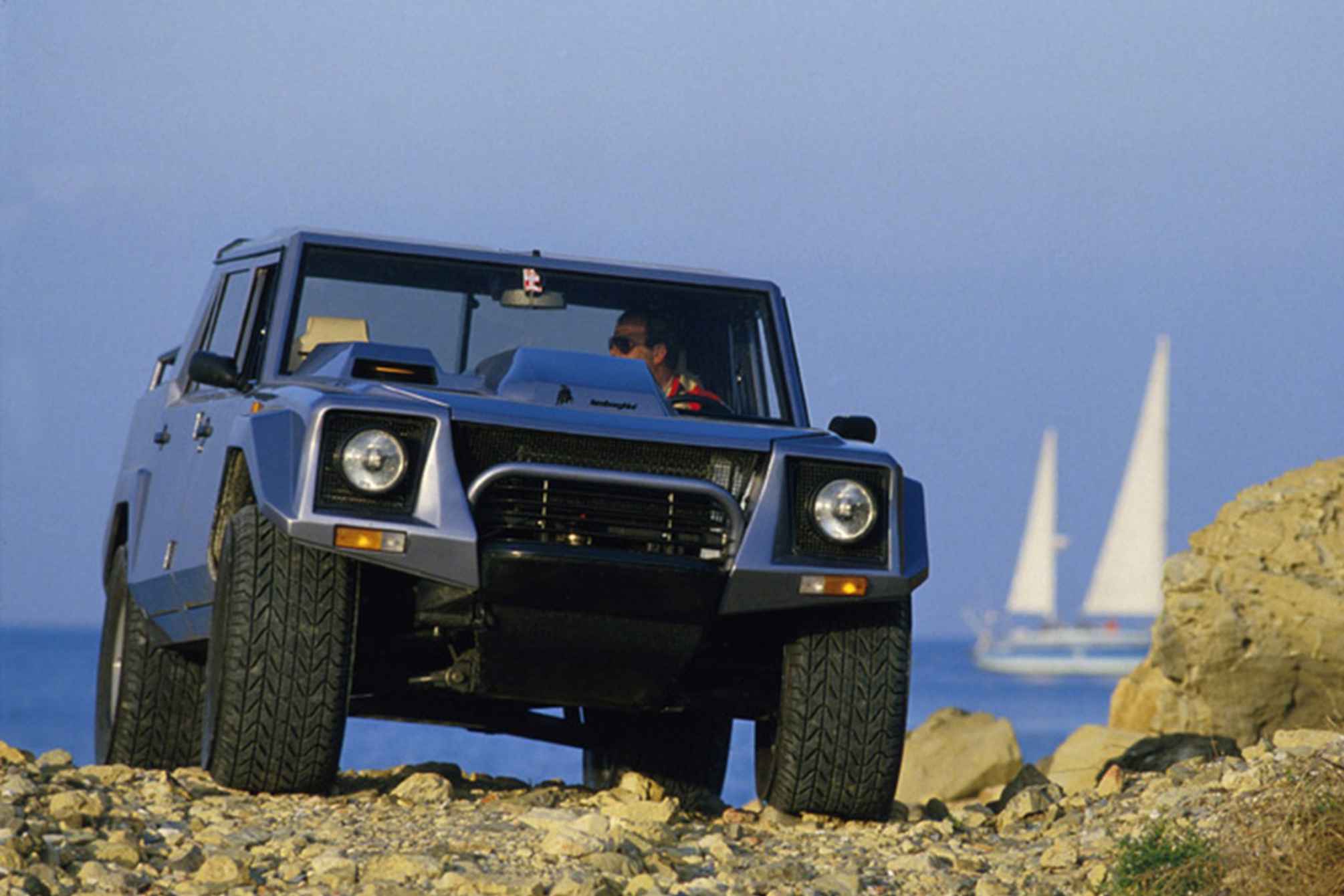
The result is a vehicle that appears less designed than imposed upon reality. It has the visual subtlety of heavy machinery. Vast planes of aluminium and fibreglass form a shape that prioritises intimidation – just the thing for despots the world over; Gadaafi apparently ordered three for himself. The bonnet bulges to accommodate the intake system, while beneath each corner sit enormous Pirelli Scorpion tyres, developed specifically for this application and capable of dealing with terrain that would defeat most vehicles outright.
Climbing aboard feels like mounting a piece of industrial equipment. Once inside, the contrast is almost comical. The underlying structure is upright and functional, yet it is smothered in leather, wood and thick carpeting. The transmission tunnel rises through the cabin like a geological feature, dividing occupants into their own padded territories. Switches are scattered with little apparent logic, but by this point you are no longer expecting coherence.
Turn the key and any remaining sense of normality disappears. The 5.2-litre V12, closely related to the unit found in the Countach and typically fed by six Weber carburettors, does not settle into a polite idle. It chatters, barks and fizzes with mechanical intent. There is nothing relaxed about it. You’re certainly awake.
Apply throttle and the entire vehicle seems to gather itself before surging forward. Induction noise builds into a deep roar, the exhaust hardens into a metallic howl, and this enormous mass accelerates with a conviction that feels faintly absurd. It is not graceful, but it is undeniably effective.
Everything about the driving experience demands effort. The clutch is heavy, the manual gearbox requires commitment, and the steering, though assisted, offers more resistance than finesse. Body movement is constant, reminding you that this is a very large object attempting to behave like something much smaller. Yet, for all that, it was capable of reaching 60mph in roughly eight seconds and continuing to speeds that feel entirely inappropriate for something of this scale.
The costs of such indulgence are as dramatic as the concept itself. Fuel consumption borders on the theatrical, necessitating a tank of around 290 litres simply to make the car usable. Braking performance is constantly working against mass and momentum, and every journey carries a sense of mechanical expenditure.
If the Lamborghini LM002 itself was an exercise in excess, then its clientele followed suit. This was never a car for the merely wealthy. It was for those who had already exhausted the obvious ways of demonstrating financial dominance and were now searching for something more theatrical. The typical buyer was not interested in subtlety or restraint. They wanted presence, spectacle and a machine that made absolutely no attempt to justify itself.
Unsurprisingly, much of the Lamborghini LM002’s early life was spent in the Middle East, where its combination of off-road capability and operatic engine note made a certain kind of sense. Here was a vehicle that could cross desert terrain at speed while announcing its arrival from several miles away. It became a favourite among oil magnates and royal families, often specified in colours and trims that made even Lamborghini’s standard palette look conservative.
Elsewhere, the car attracted a different but equally committed audience. European aristocrats, collectors and a handful of celebrities found themselves drawn to its sheer improbability. It was less a rational purchase and more an acquisition, something to be added to a collection that already contained everything else. Owning one suggested not just wealth, but a willingness to indulge in something knowingly excessive.
There were, of course, attempts to push the concept even further. Special orders appeared, including the estate-style LM002 variants and rumours of even more outlandish specifications commissioned by particularly enthusiastic clients. Each one reinforced the same basic idea. This was not a vehicle shaped by market demand. It was shaped by the desires of a very small group of people who could afford to ignore such constraints entirely.
Modern Lamborghini SUVs are faster, more capable and infinitely more sophisticated. They are also the product of committees, regulations and shared engineering logic. The Lamborghini LM002 belongs to an era when none of that seemed especially important.
What remains is a monument to excess in its purest form. It is loud, demanding, inefficient and completely unreasonable. It is also unforgettable. A machine born from a failed military idea and elevated, against all sensible judgement, by the addition of a V12 from Sant’Agata Bolognese.
Rambo Lambo or modern Urus, which would you rather have parked on your drive, and why?