Words and Photography: Roland Brown
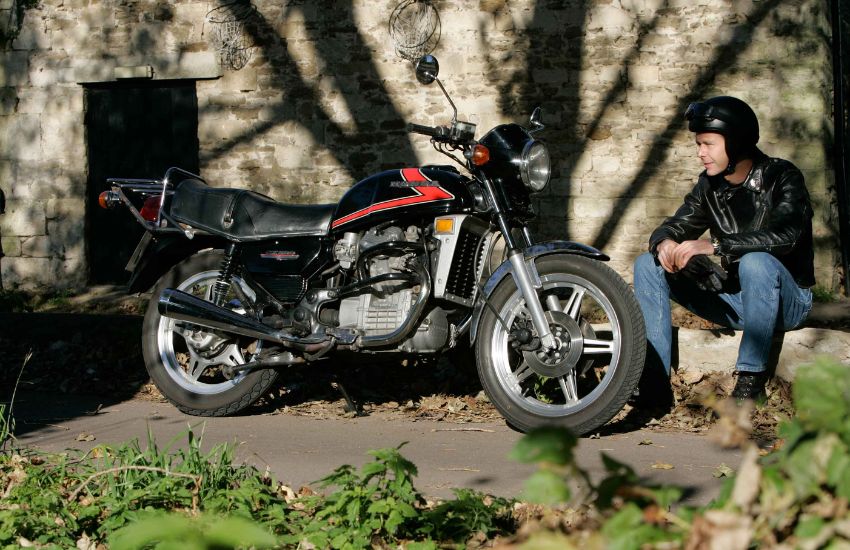
The Honda CX500 has always generated a wide variety of opinions, but I hadn’t expected my own view to change so dramatically, or so fast.
Like many young riders, I’d had little time for Honda’s V-twin following its launch in 1978. The “Plastic Maggot”, as the curiously styled CX was soon disparagingly nicknamed, seemed to sum-up all that was wrong with many Japanese motorcycles.
It was too big, soft and heavy for a “middleweight” – and too complicated. Why did it have liquid-cooling, many of us wondered, when a transverse V-twin’s cylinders are perfectly positioned to be cooled by fresh air? And boy, was it ugly…
My disdain held through the early Eighties, when the Honda became the despatch riders’ favourite and London’s streets were teeming with scruffy, high-mileage CXs, top-boxes bungeed to their pillion seats and radios crackling. Despite being a bike journalist by then I didn’t ride one and had no great desire to.
Yet years later here I was, barely half an hour into my first ever ride on a CX, realising that it was not only a much better bike than I’d always imagined, but having to admit to myself that I was really enjoying the ride.
The V-twin motor was smooth, flexible and had an appealingly rev-happy character. And despite its bulk the Honda was handling well too, feeling much less ponderous and more entertaining than I’d expected.
If the CX feels this good now, I couldn’t help thinking, no wonder it sold so well back then. And plenty of others had clearly felt the same way. For every speed- and style-obsessed motorcyclist who mocked the Honda, there was another, more practical rider who loved it.
The long-distance types, especially the professionals, praised not only its blend of comfort and real-world performance but also its dependability and ease of servicing. They accepted its size and weight, and happily ignored its styling.
Honda’s ambitions for the CX had been much loftier than a role as a courier workhorse. It was designed as a sports-tourer: a sophisticated road-burner that would appeal through its performance and handling as much as its practicality.

The 496cc, eight-valve engine produced a maximum of 50bhp at 9000rpm; respectable if not outstanding for a mid-capacity machine. Honda launched the CX at the Nogaro racetrack in France, in an attempt to demonstrate that it was quick and sporty, despite weighing 212kg with fuel.
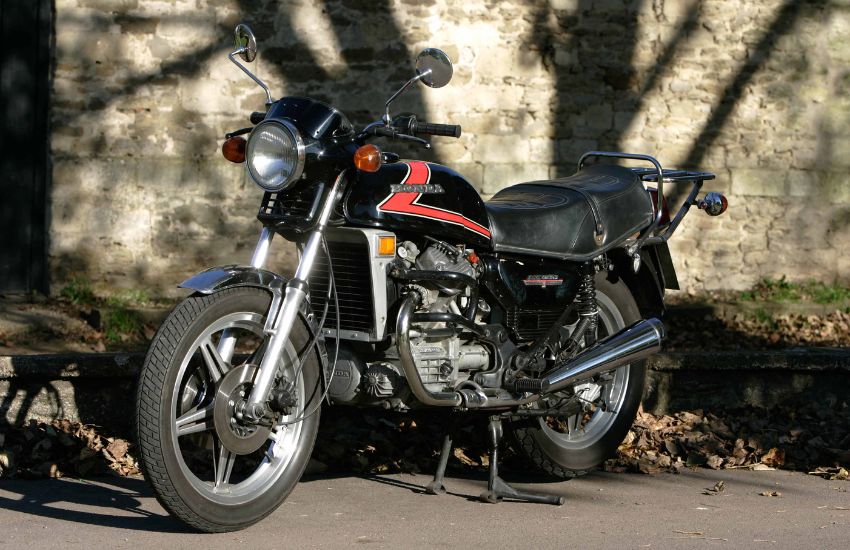
Its engine layout was technically original. The transverse V-twin’s cylinders were set 80 degrees apart. The barrels were “twisted” by 22 degrees, angling the intakes towards the centrally mounted Keihin carburettors, and the exhausts outwards.
This arrangement gave room for the rider’s knees and allowed straight intake ports, but would have made an overhead camshaft design difficult. Instead the CX relied on a single, chain-driven camshaft between the cylinders, plus short pushrods that operated two valves each.

The alternator was driven off the rear of the crankshaft, allowing the clutch to turn in the opposite direction. This eliminated the torque reaction lurch that was familiar to riders of BMW boxers and Moto Guzzi V-twins on blipping the throttle. As with those engines, the CX’s longitudinal crankshaft facilitated a shaft final drive.
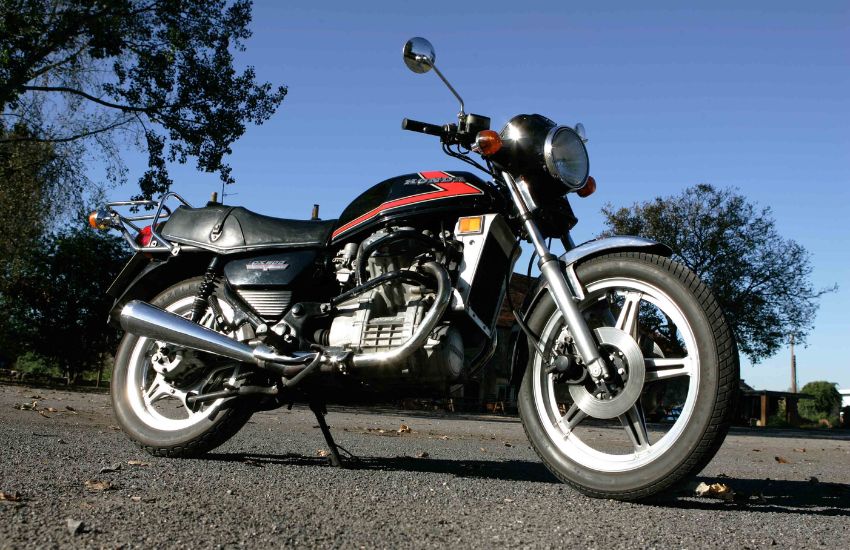
The twin-shock chassis featured a large steel frame spine between the cylinders, plus pressed-steel sections at the swing-arm pivot. Wheels were Honda’s aluminium Comstars, with a 19-inch diameter front. Braking was by two small front discs, plus a drum at the rear.
What the CX lacked, to most eyes, was style. Its designers had managed to emphasise rather than hide its weight, thanks to a plastic headlamp nacelle, and bulbous tank and sidepanels. The thick black seat resembled a giant slug. The Honda looked particularly dowdy alongside the slim, aircooled 500cc V-twins from Italian firms Moto Guzzi and Moto Morini.
Press response was mixed. Bike magazine’s review began: “If looks could kill then this one should be six feet under”, before praising an “amazingly comprehensive specification and remarkable turn of speed at a price that is unbeatable”. SuperBike’s headline was a damning “Float like a butterfly – sting like a butterfly” but positive comments included: “I’d go as far as to say that the CX500 is the best handling Honda ever.”
The CX was not helped by the timing of its arrival in 1978. This outstanding motorcycling year also saw the launch of Honda’s spectacular CBX1000 six, Suzuki’s GS1000 four, Kawasaki’s Z1000-based Z1-R café-racer and Laverda’s 1200 triple. No wonder the CX held little appeal for sports-oriented riders.


High-profile mechanical problems made things worse. Shortly after its launch, the V-twin engine suffered with both top-end and crankshaft failures. The trouble was cured relatively quickly but was expensive and embarrassing for Honda, and gave the CX a very poor start.
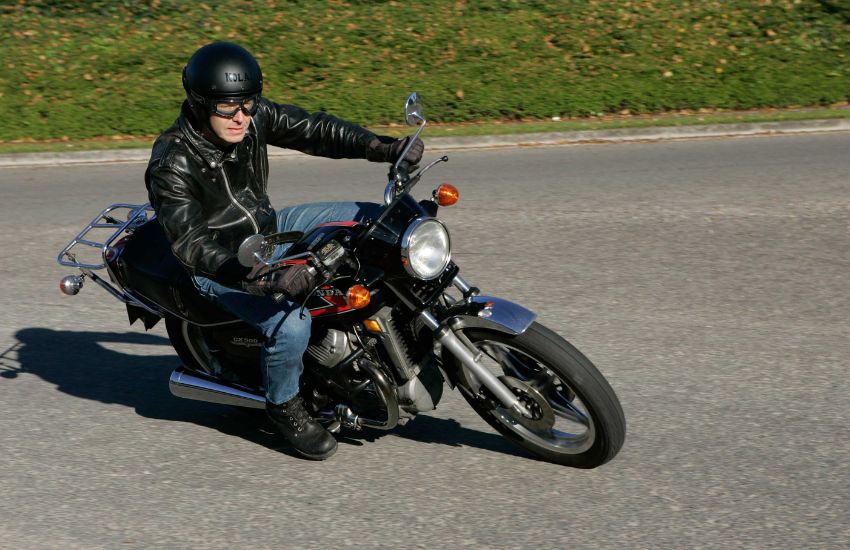
The model’s subsequent success had earned respect while doing little to make me want to ride one. But the opportunity of a spin on an unrestored CX – standard apart from upgraded Koni rear shocks, crash-bars, and a rear carrier that would have been typical fitment when this bike was first sold in 1980 – was too good to miss.
My first impression was misleadingly predictable. The Honda felt tall and heavy at a standstill, its slightly raised bars and thick seat giving a roomy, near-upright riding position. Its engine fired up with a twittering, efficiently silenced exhaust note that did little to inspire enthusiasm.
But the Honda felt flexible and strong as I pulled away, and I was pleasantly surprised that it seemed distinctly less soggy than I’d expected. That 50bhp output isn’t much for a bike weighing over 200kg, but was enough to send the CX chugging forward at a respectable rate.
Equally importantly, the Honda was distinctly rev-happy for a pushrod-operated V-twin. I’d expected a flexible but dull bike that was easy to ride and ran out of breath quickly at higher revs. But the CX wasn’t like that, as I maybe should have guessed given that its peak power was delivered at 9000rpm.

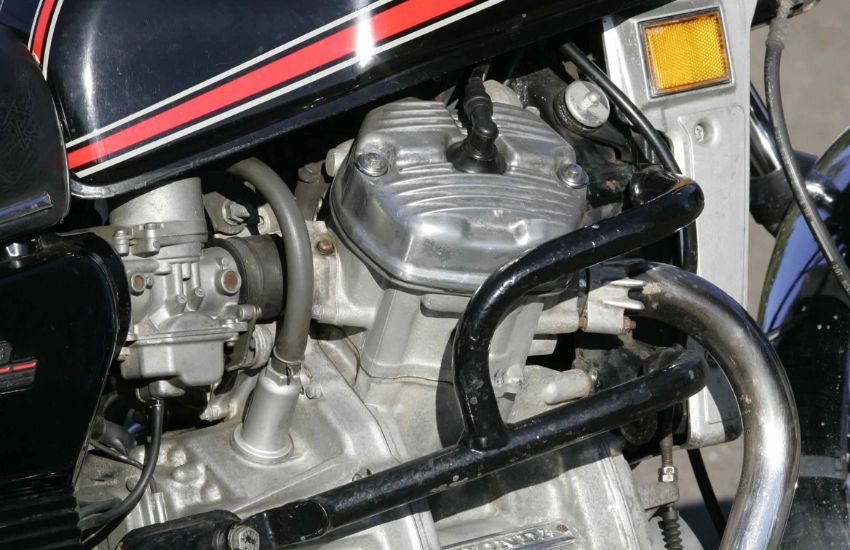

Sure, the Honda pulled well from low down, and responded crisply in the midrange. It sat smoothly at an indicated 80mph, feeling as though it would happily do so for ever. And the eight-valve V-twin also felt good up near its 9700rpm redline, encouraging me to keep it spinning with frequent use of the five-speed gearbox.
This sporty character came as a pleasant surprise, and the same was true of its chassis performance. Given that weight and shaft drive, I’d expected an uninspiring ride. But the CX handled well, helped by its capable Koni shocks, and felt taut despite the big squashy seat that helped make it very comfortable.
Steering wasn’t exactly sharp, and the front end was slightly soft, especially under hard braking. But the bike could be flicked into turns reasonably easily, and steered with enough precision and control to encourage enthusiastic cornering. Straight-line stability was flawless as the Honda headed towards its top speed of about 105mph.
Braking was adequate rather than sharp, with a fair bit of lever pressure needed to activate the small front discs. But the rear drum gave useful assistance. And at least those discs reportedly still did worked in the wet, unlike many other bikes’ systems at the time.
That word “worked” crops up a lot with the Honda CX500, which goes a long way to explaining the model’s success. It worked in terms of being efficient, with all its components doing their jobs (teething problems apart). And that in turn made it such a good working bike, for couriers and commuters alike.


Easy servicing, generous fuel range and a competitive price (£1200 in the UK in ’78) were further plus points. Despite all that, the CX was never really accepted as a sports-tourer. Too many other bikes provided more power, sharper handling and more style, even if most of them were far more expensive.
Honda tried to add visual appeal, firstly in 1981 with a high-handlebarred, far-rear-tyred “factory custom” variant, the CX500 C-B, that enhanced neither performance not street credibility. The following year’s CX500 Sport adopted Honda’s smoother “Eurostyle” bodywork plus monoshock rear suspension, and was easier on the eye. But its engine was unchanged, the price had ballooned to over £1700 and the Sport made far less impact than its predecessor.
All of which reinforced the impression that Honda had got the CX500 mostly right first time. On returning this bike to its owner, I couldn’t help concluding that the much mocked Plastic Maggot would have sold in even bigger numbers if more motorcyclists had actually got round to riding one.
Read more:
How to Get into Classic Bike Collecting
Fireblade: How Honda Bottled Lightning
The Yamaha RD350 was the Best Bike of the ’70s




Had 2 just awesome in my mind nearly as good as my other 500 favourite the very pretty and damned superb triumph tiger 100 1966. What a machine that was.must have been madto sell it.
I also had 2.. the original and then traded it in for the 500B with the reverse comstar wheels in black.
Certainly one of my favourites, and I’ve had plenty to compare it to.
The CX500 looked visually deformed. The paying public are not required to see past that.