Words and Photography: Roland Brown
The ride from south London to Biggin Hill in Kent took less than half an hour, and was a fine way to spend an autumn afternoon. The BSA Spitfire was running perfectly, its torquey engine and capable chassis blending to give lively performance on narrow lanes and open A-roads alike.
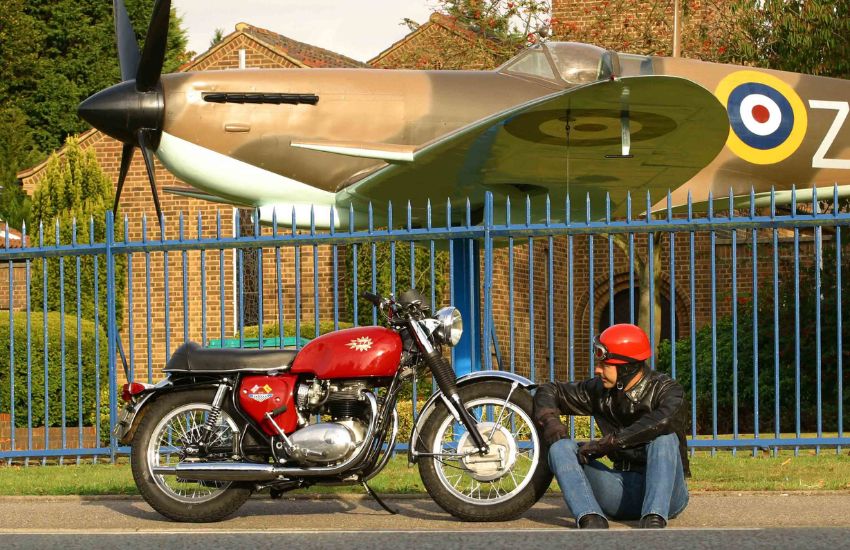
When I reached the former World War II airfield and parked the Spitfire in the shadow of a replica of its famous winged namesake, it was easy to understand why BSA’s bosses had thought the plane’s name ideal for their hot new roadster on its launch in 1966.
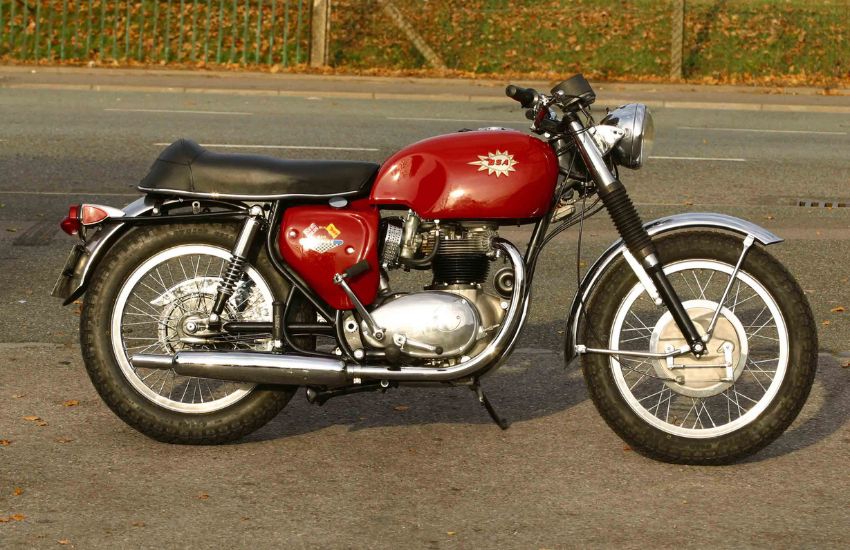
With its bright red paintwork, and a tuned engine producing over 50bhp, the Spitfire was BSA’s top-of-the-range sports model six decades ago. Comparisons with Supermarine’s fast and stylish fighter plane were excusable, if not strictly justified.
On my ride this nicely restored Spitfire had upheld the name’s links with high performance, at least when allowance was made for its age. As well as having a fair turn of straight-line speed, the BSA handled well, and stopped with unusual enthusiasm for a bike of its era, thanks to its big twin-leading-shoe front drum brake.
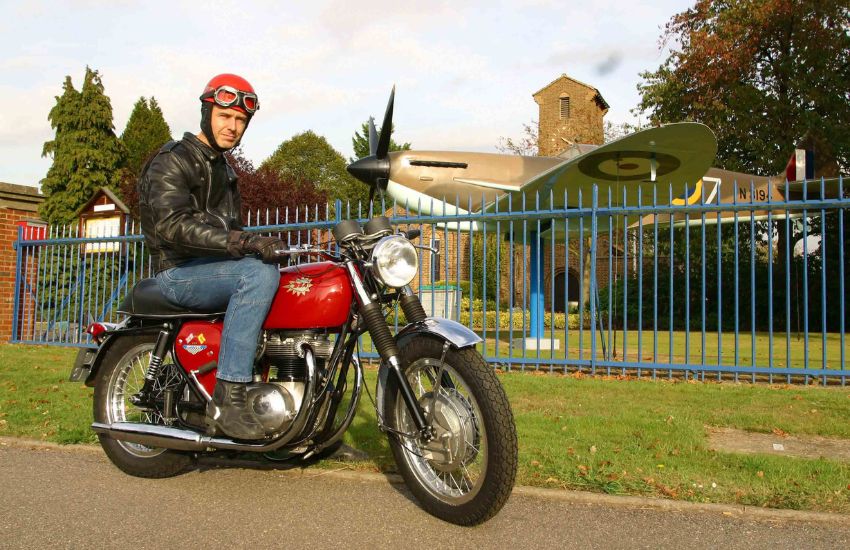
But if this nicely restored MkIV, dating from 1968, was a fine example of the last and best model of BSA’s Spitfire series, there can be no denying that the two-wheeler of that name failed to approach the impact of the flying machine that inspired it.
While the fighter plane will forever be revered as a hero of the Battle of Britain, its two-wheeled namesake made headlines for being as fragile as it was fast.
BSA designer Bert Hopwood can surely not have imagined this end result in spring 1950 when he penned the marque’s original 646cc parallel twin engine, essentially a larger-capacity version of the firm’s 500cc A7 unit. The A10 Golden Flash, launched later the same year, produced 35bhp and soon earned a reputation for smoothness and reliability.
The BSA’s basic overhead-valve engine layout, with pushrods operated by a single four-lobe camshaft (rather than twin cams, like rival Triumph’s engine), remained unchanged as its performance was gradually increased during the Fifties. Models including the Super Flash and Super Rocket brought peak output above 40bhp by the end of the decade, by which time top speed had risen past the 100mph mark.
Interest in BSA’s twins was boosted in 1964 with the introduction of the first sports model, the A65 Rocket, whose 105mph top speed and aggressive looks proved popular. The following year’s A65
Lightning, featuring twin carburettors, was even faster – especially in Lightning Clubman trim with tuned engine, clip-on bars, rearset footrests and humped racing seat.
The Spitfire replaced the Lightning Clubman as BSA’s top performance machine in 1966, when curiously it was called the Spitfire MkII Special although there had been no MkI version in the past. BSA had used the Spitfire name a couple of years earlier for the Spitfire Hornet, but this was an off-road model with open exhaust and no lights, created for the American export market, so was far from the new model’s predecessor.
BSA clearly deemed the Spitfire name worthy of greater exposure, and the MkII machine was an outstanding motorbike – at least on paper. To the already racy spec of the Lightning Clubman, which had high-compression pistons plus a close-ratio gearbox, it added a pair of Amal GP2 carburettors.
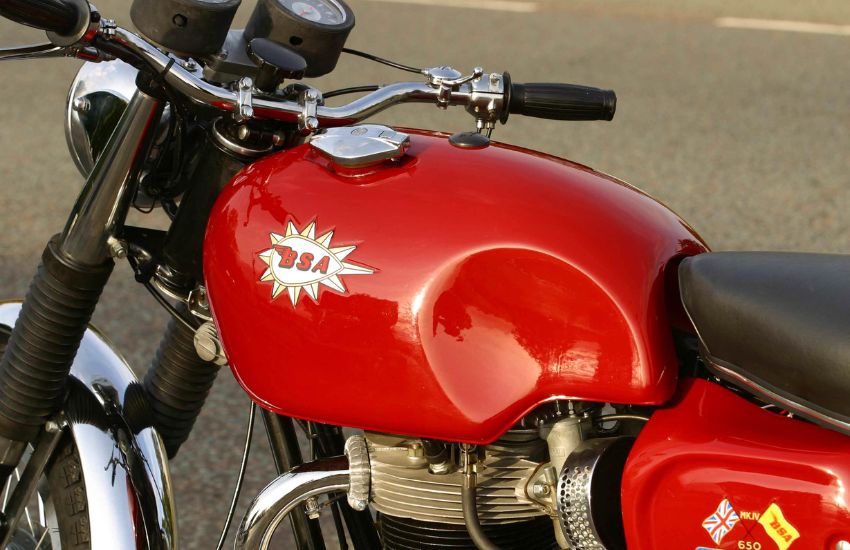
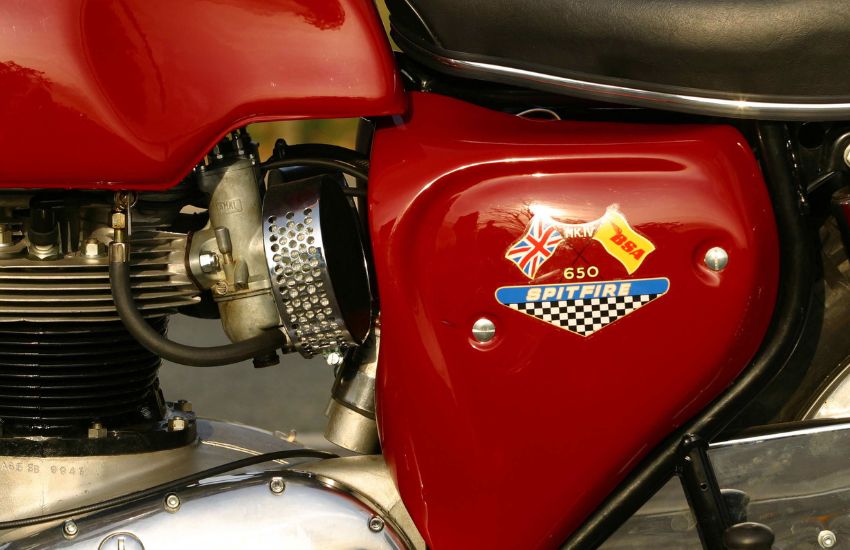
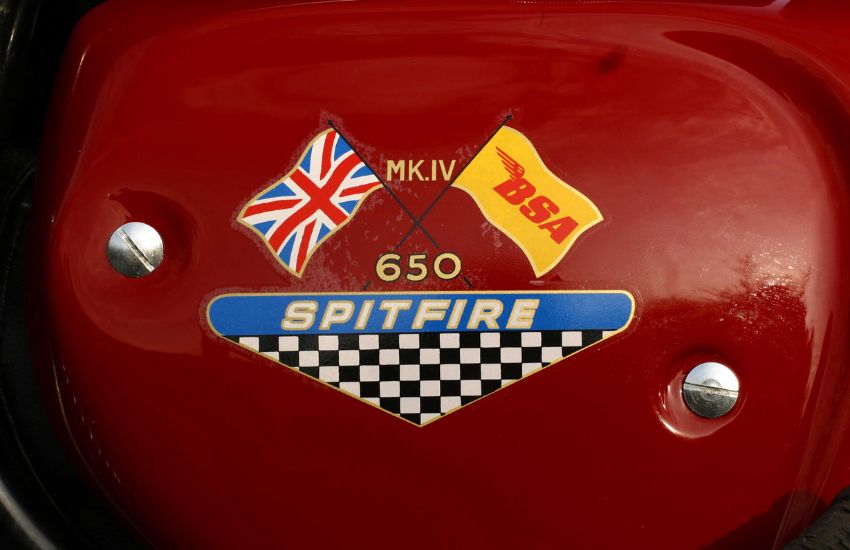
The improved breathing increased peak power to 54bhp at 6500rpm – more than 50 per cent up on the original A10’s output. This was impressive performance in 1966, the year that England won the World Cup, the Beatles and Rolling Stones were battling in the charts, and London’s King’s
Road was the centre of the swinging Sixties.
The Spitfire also benefited from the 12-volt electrics and the chassis changes that BSA introduced across all its twins in that year. The chassis mods included a revised, twin-downtube steel frame, new front forks developed through the Birmingham firm’s scrambles team (featuring rebound damping for the first
time) plus new Girling shocks.
In addition the BSA Spitfire boasted the larger front drum brake and full-width alloy hub that had previously been an option on the Clubman. Lightweight alloy wheel rims helped bring weight down slightly to 174kg.
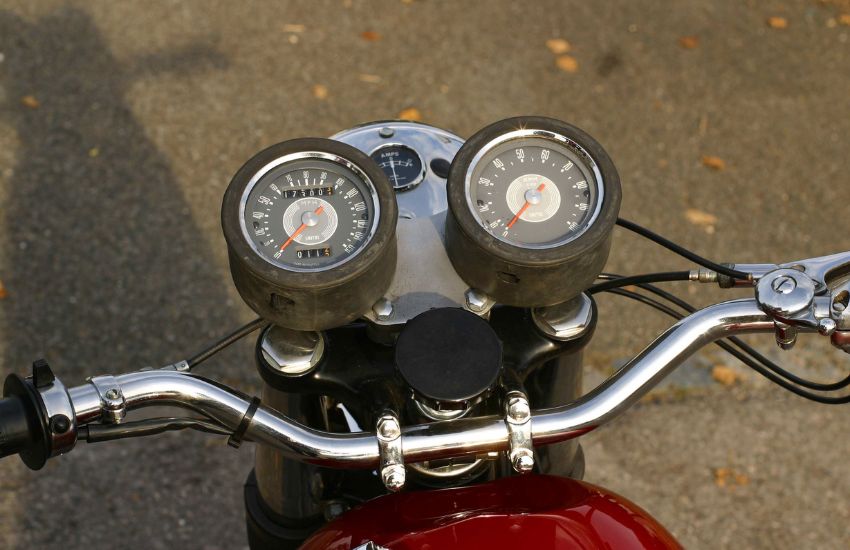
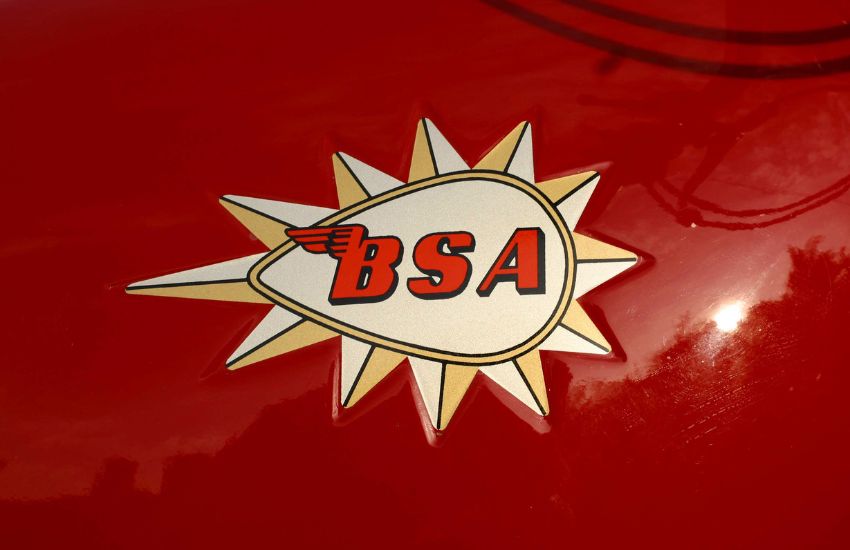
Finished in red, the Spitfire came with a tiny fibreglass fuel tank that held only eight litres (there was an 18
litre option) and looked very handsome. For a time it went every bit as well as it looked, too. The hotted-up engine gave lively acceleration plus a top speed of 120mph. Handling from the new chassis was more than acceptable, and the Spitfire had the performance to match any standard production machine on the road.
But sadly for the proud owners of a new Spitfire MkII, this happy state of affairs normally did not last long, because the model’s introduction coincided with a disastrous engine revision across all BSA’s twins. Changing the crankshaft main bearings from ball to roller design was an ill-conceived engineering solution that did not hold the crank sufficiently securely.
The roller bearing allowed sideways movement in the crank, which soon generated wear. Coupled with the BSA twin’s barely adequate lubrication system, the factory’s poor level of crankshaft balancing, and the inevitable parallel-twin vibration, the result was potentially disastrous. The right main bearing bush wore, turned in its housing, cut off the oil supply to the bearings, and… BANG!
Inevitably, the most vulnerable engine was the high-revving, high-compression unit in the Spitfire – which soon developed a terrible reputation for unreliability. Numerous hard-riding owners found themselves
examining their conrods through a hole in the crankcases.
BSA’s response was not exactly swift; typically of a firm which by the late Sixties was already in serious financial trouble, along with the rest of the British bike industry. The main change for the Spitfire MkIII of 1967 was that Amal Concentric carburettors replaced the racing GP2s. The engine also gained a finned top for its rocker box, plus an access cover to the rotor in the chaincase.
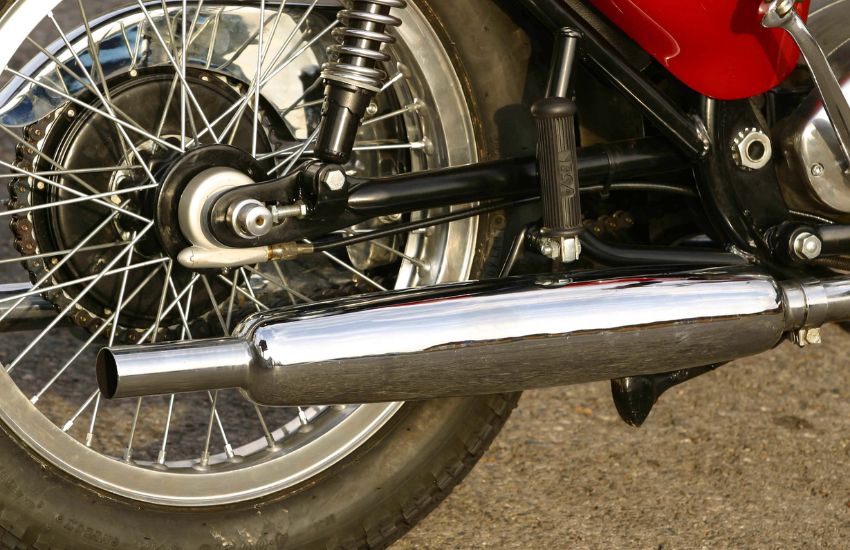
Predictably this did nothing to shed the Spitfire’s deserved reputation for unreliability when its performance was used to the full. And the same was true of this model, the MkIV of 1968, whose significant changes were to cycle parts: the introduction of a big eight-inch twin-leading-shoe front brake, plus exposed springs for the rear shocks.
At least, by now, BSA Spitfire owners knew that the motor must be treated with care, and examined regularly for wear, if expensive problems were to be avoided. And luckily for present day BSA enthusiasts, these weaknesses can be cured fairly easily and cheaply.

A new and more rigid oil pump, plus the substitution of the vulnerable crankshaft bush with a ball and roller bearing that holds the crankshaft more securely, goes a long way to making the Spitfire MkIV the bike it should always have been.
Thankfully those modifications had been made during the rebuild of this very sweet example, which started first or second kick with a healthy bark from its pipes, didn’t leak oil and was running just as smoothly and strongly at the end of my ride as at the beginning.
Slightly more smoothly, in fact, because shortly after setting off I thought the BSA’s gearchange was faulty. Changing down was no problem, but second and third gears were very hard to find going up through the four-speed box.
After a couple of miles I was debating whether I should head back. Then I realised that the problem
had disappeared and the Spitfire was shifting cleanly, presumably because the gearbox had warmed up.
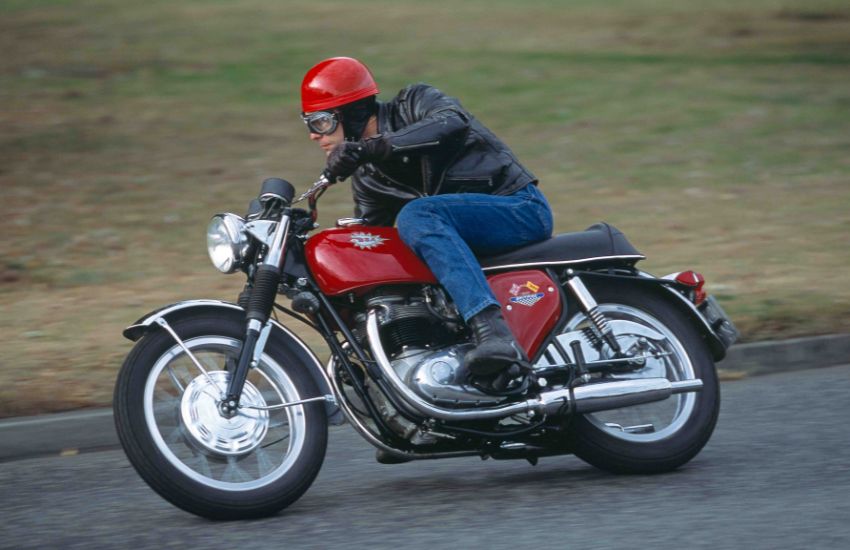
Mindful of the Spitfire’s reputation and the fact that its engine had recently been rebuilt, I kept the revs down and didn’t get near that genuine 120mph top speed that had impressed testers and tempted owners in the Sixties.
At lower revs the BSA was very pleasant, its delivery seemingly unaffected by the motor’s relatively high state of tune. The Concentric carbs gave a crisp response, and the bike pulled so strongly at about 50mph in top gear that once out of town the by-now sweet-shifting gearbox was rarely needed.
Handling was good, too, which was not surprising because BSA’s 1966 chassis updates had proved much more successful than the engine modifications. The twin-downtube frame was reasonably rigid, and
the MkIV’s freshly exposed fork springs did a good job of soaking up the bumps.
At times the front forks felt a bit soft, but this was generally simply due to the impressive power of that big twin-leading-shoe front drum, which made an important contribution to the MkIV’s street-racer style as well as its stopping performance.
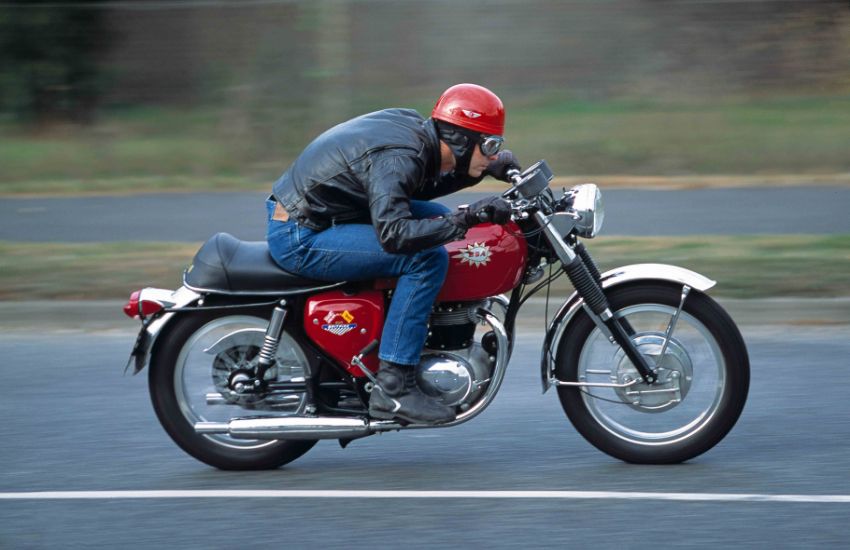
All of which suggested that this elderly Spitfire was not merely as good as new, it was considerably better than on the day it left BSA’s plant at Small Heath in Birmingham almost 60 years ago.
Back then, the racy twin’s well documented mechanical problems helped ensure that its reign as BSA’s sporting flagship was short. In 1969 it was dropped from the range to make way for the new Rocket Three triple.
In terms of pure sprinting speed, the Spitfire was arguably as good as the firm’s twins got before the factory closed in 1973. But given its reliability record, even few BSA enthusiasts would claim that it lived
up to its illustrious name.
Have you ridden or owned a BSA Spitfire? We would love to hear from you in the comments below.
Read more classic motorbike content
The Moto Guzzi Airone was fast for the Fifties, even with no speedometer
MV Agusta 750S
Norton Navigator


Sadly a bygone time when we could buy British motor cycles and cars all stylish but lack of investment and people buying British and being proud instead of knocking our Heritage now what have we got cars advertised that I have never heard of be carefully of change it’s not always for the best of even that good